
Species Guides
Slime Mold for Springtails: How to Feed McDo & Santa Claus

Nov
Slime mold for springtails
Short answer: McDo and Santa Claus springtails belong to the family Neanuridae, and they cannot eat dry food. Their mouthparts are built to pierce and suck, so they feed on the liquid contents of live slime mold. To keep a colony healthy, give them a small piece of live, gentle slime mold on the substrate regularly, keep the soil damp but never flooded, remove old food, and keep them separate from fast-growing springtails. This guide explains why, then walks you through setting up and feeding a culture step by step.
These springtails are some of the most beautiful microfauna in the bioactive hobby: red, slow, unable to jump, and large enough to see without squinting. They also have a reputation for being difficult. In our experience and in the experience of many breeders, that reputation comes mostly from one misunderstanding: people try to feed them like ordinary springtails. Once you understand their diet, they become far more manageable.
In this guide
- What are McDo and Santa Claus springtails?
- Why they cannot eat normal springtail food
- What is slime mold?
- Gentle vs aggressive slime molds
- How springtails feed on slime mold
- How these springtails grow
- Setting up a culture
- How to feed slime mold, step by step
- Making a feeding station
- A simple feeding schedule
- Gut loading the slime mold
- Keeping slime mold healthy
- Moisture, ventilation and temperature
- What growth to expect
- A 12-week plan
- Troubleshooting
- Common mistakes
- Tank mates and other springtails
- Using them in a vivarium
- Where to start
- Frequently asked questions
What are McDo and Santa Claus springtails?
Springtails are tiny arthropods in the group Collembola. Most hobby species are small, white or grey, and jump when disturbed. McDo and Santa Claus springtails are different in almost every way, and they belong to the family Neanuridae.
McDo springtails
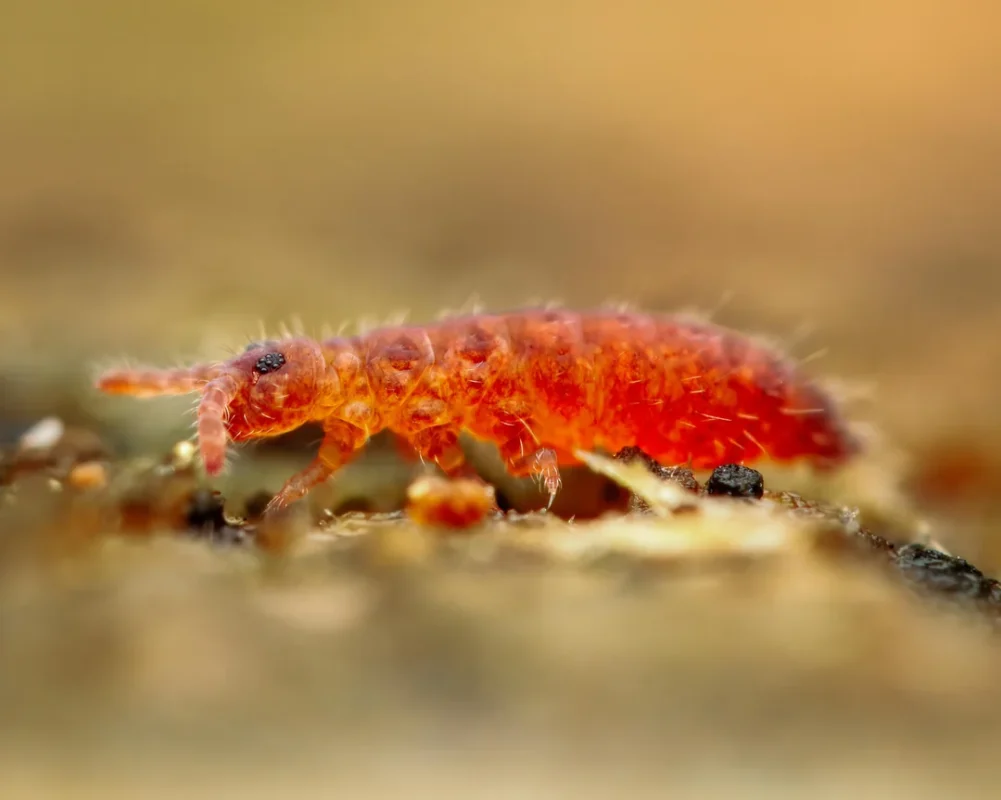
McDo springtails come from the humid rainforests of the Philippines. They are red with a bold, high-contrast yellow pattern, and their bodies are covered in fleshy bumps, called tubercles. They are large for springtails, often reaching roughly 3 to 5 millimeters. That striking coloring is a warning signal to predators, a trait biologists call aposematism, and it makes them one of the most visually dramatic microfauna you can keep.

Santa Claus springtails
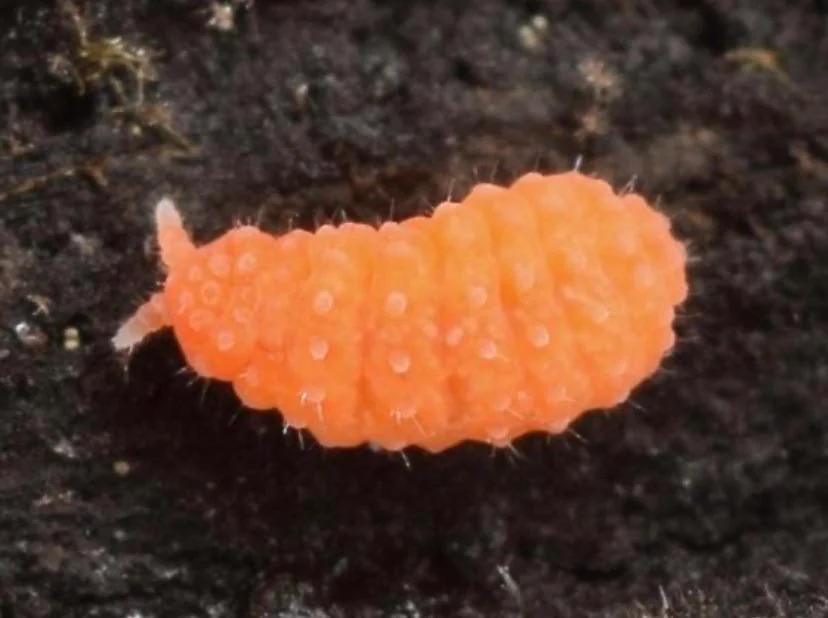
Santa Claus springtails, also sold as Redford White, are another Philippine Neanuridae with a red and white look. They are a collector species in their own right, popular for their festive coloring and for the way they stand out on moss and bark. Santa Claus is a different species from McDo, and the two are often confused. Breeders caution that names such as Santa Claus, Redford White, Jollibee and Thai Red Spiky refer to different animals from McDo, so check which one you are buying. You can see our Santa Claus springtails and our rare and exotic springtails for current stock.

They cannot jump
Both McDo and Santa Claus have lost the jumping organ, called the furca, that gives common springtails their name. They move at a slow, dignified pace and will not leap out of a container when you open the lid. That makes them calm and easy to observe, and it makes escapes much less of a worry than with fast, jumping species.
Why they cannot eat normal springtail food
Common springtails, such as Tropical White, have chewing mouthparts. They graze on yeast, flakes, fungi, algae and decaying plant matter. You can feed them almost anything soft and finely ground.
Neanuridae are different. Over a long evolutionary path, they specialized so strongly that their biting apparatus is largely gone. Their mouthparts resemble a piercing and sucking probe, designed to puncture a cell and draw out the liquid contents. This feeding style is called myxophagy when the food is slime mold. It means:
- Flakes, pellets, yeast powder and dried leaves are not food for them. They physically cannot process hard or dry material.
- They need living, moist food that they can pierce and drink from.
- Without access to live slime mold, a colony can slowly starve, even if the culture looks tidy and well kept.
This is the main reason keepers who treat McDo like ordinary springtails lose their colonies. The animals do not die suddenly. They simply fade over a few weeks. If you are used to common species, our guide to springtail culture care covers standard feeding, and it is worth reading to see how different the two approaches are.
What is slime mold?
Slime mold is one of the strangest organisms you can keep. It is not a plant, not an animal and not a true fungus. Slime molds belong to a group of single-celled organisms called protists, and the ones commonly kept in culture are in the Myxogastria. Despite the name, they are not molds in the usual sense.


The life cycle
A slime mold has several stages.
- The plasmodium: the active, feeding stage. It is a single, giant cell with many nuclei that spreads out in a network of veins, often bright yellow. It moves toward food and away from light and dryness. This is the stage springtails feed on.
- The sclerotium: a dormant, dried form that the slime mold makes when conditions are poor. It looks like a hard, brittle crust. Many suppliers ship slime mold in this form because it keeps well. Add moisture and food, and it can wake up.
- Spores: a third stage, used for reproduction, which hobbyists seldom deal with.
What slime mold eats
Slime molds feed on bacteria, fungal spores and tiny particles of organic matter. In culture, they are commonly fed plain oat flakes, which they engulf and digest. This is what makes them useful here: a slime mold that has been fed well becomes a nutritious, living food source that is ideal for sucking mouthparts.
What it needs to grow
- Moisture: it needs a damp surface, but standing water can drown it.
- Darkness or dim light: most hobby slime molds avoid bright light.
- Room temperature: comfortable household temperatures suit most cultures.
- Food: oat flakes or a similar bland, starchy food.
Always follow the instructions that come with your own culture, because different strains and forms behave differently. Our live slime mold page lists what we offer.
Gentle vs aggressive slime molds
Not every slime mold is a good partner for springtails. Breeders warn that some fast-growing, aggressive types behave like predators when they are hungry. A starving, vigorous slime mold can overrun and digest small animals that wander onto it, including springtails.
This matters most when your colony is small. A starter group of ten or twenty animals can be wiped out quickly by an aggressive growth. For this reason, many breeders recommend:
- Choosing a gentle, slow-growing slime mold that is sold specifically as a food for springtails.
- Avoiding fast, aggressive types, especially at the start of a colony.
- Keeping the slime mold well fed before offering it, so it is not hungry.
- Offering small pieces, not a large mass.
If you are unsure which type you have, ask the seller. You can also contact us and we will tell you what to expect from ours.
How springtails feed on slime mold
Once you place a piece of slime mold into a culture, the springtails find it by smell and move onto it. They cluster on the surface and push their mouthparts into it, drinking the fluid inside. A healthy colony will gather on a fresh piece within hours.
You may notice a few things:
- Clusters on the food: several animals feeding at once is a good sign.
- Plump, bright bodies: well-fed animals look rounded and richly colored.
- Shed skins: springtails molt many times in their lives. Pale, crumpled skins in the substrate mean they are growing.
- Young animals: tiny, pale juveniles appearing on the substrate show the colony is breeding.
If the springtails ignore the food, something is usually wrong with the piece or the environment. Check the troubleshooting section.
A closer look at how these springtails grow
Understanding the life cycle makes feeding decisions much easier, because you can read what the colony is telling you. Like other springtails, McDo and Santa Claus start life as eggs, hatch into tiny juveniles that look like pale miniatures of the adults, and grow by molting.
Eggs and juveniles
Eggs are tiny and often laid in the substrate, in small groups. You will rarely see them without a magnifying glass. The juveniles that hatch are pale and very small, so a colony can look empty for a while even when it is breeding well. They tend to gather near food and in damp, sheltered spots.
Molting
Springtails molt many times, even as adults, shedding their outer skeleton and growing a new one. Right after a molt, an animal is soft and pale, and it needs calcium and good nutrition to harden properly. This is one reason a nutritious, well-fed slime mold matters. A colony that is molting well leaves behind small, pale, crumpled skins in the substrate.
Color and condition
A healthy McDo is vividly red with sharp yellow markings. A healthy Santa Claus shows clean red and white contrast. If animals look dull, shrunken or washed out, they may be underfed or dehydrated. Compare them with photos of healthy animals and adjust feeding and moisture.
Why patience helps
Because these species are specialized and slow-moving, they do not explode in numbers the way common white springtails do. A colony that is simply holding steady and showing a few juveniles is usually doing fine. Watch trends over weeks, not days.
Setting up a McDo or Santa Claus culture
You do not need much. A simple container with the right substrate is enough. The details below reflect methods that experienced breeders report using, and they are a good starting point. Adjust them if your own culture tells you otherwise.
The container
A container with a capacity of about 350 milliliters (roughly 12 ounces) or more is enough for a starter colony. Use a clear or translucent container with a secure lid so you can watch the animals. Larger containers hold humidity more steadily, but a small one is fine for a few animals. The animals cannot jump, so you do not need tall walls.
The substrate
Spread a layer of at least 2 centimeters (about an inch) of plain, chemical-free soil on the bottom. The soil should have no fertilizers or pesticides. Some breeders scald the soil with boiling water or bake it in the oven first. This is not strictly required, but it can help, because it removes wild mites and other organisms that might compete with your springtails for food or prey on them. Let the soil cool fully before use.
The moisture
This species is forgiving about humidity as long as you avoid two extremes. The substrate must not be bone dry, and it must not be a flooded swamp. Large springtails can suffocate in standing water, and slime mold does not survive well when everything is soaked. Aim for soil that feels like a wrung-out sponge: damp throughout, with no puddles.
Ventilation
Here, experienced breeders disagree with the usual advice to add lots of air holes. Some report that a sealed container with little or no ventilation works best for a small colony, because holes cause fast, uncontrolled drying, which is a common cause of collapse in young cultures. Once the colony reaches hundreds of adults, ventilation matters less. If you try a sealed container, you must remove old food promptly and watch for condensation and runaway mold. If you see problems, add a very small amount of airflow and watch the result.
The starting group
A group of about ten adults is enough to start. Place them gently on the surface and give them a piece of slime mold straight away. Our Santa Claus springtails are sold in packs of ten, which suits this method well.
Where to keep the culture
Keep the container at comfortable room temperature, out of direct sun and away from heaters and cold windows. Both species are tropical, so avoid chilly spots. A shelf in a quiet room works well. These animals do not need bright light.
Keep them separate
Keep your McDo or Santa Claus in their own container. Fast, aggressive springtails such as Folsomia candida can outcompete them for food in a small space. We cover this more in the tank mates section.
How to feed slime mold, step by step
- Check your slime mold. It should be damp, healthy and, in its active form, a bright yellow, spreading mass. If it is dried and crusty, it may be in its dormant stage and needs reviving first, following the instructions that came with it.
- Prepare a feeding spot. Choose a clean piece of bark, a leaf or a small flat surface, and place it on the substrate away from the walls of the container. This keeps the food off the soil and makes it easy to remove later.
- Cut a small piece. Use clean tweezers or a clean utensil to take a small piece of slime mold, about the size of a coin or less for a small colony.
- Place it on the feeding spot. Set the piece down gently without squashing it.
- Close the lid and wait. The springtails usually find the food within hours.
- Check after a day or two. You should see animals gathered on the food. If the piece looks shriveled, moldy or empty, remove it and replace it.
- Remove old food. Take out dried, moldy or used-up pieces. Old food invites mold and mites.
- Record the date. Write the feeding date on a label so you can keep a steady schedule.
If your colony is large, offer more than one piece in different spots, so the animals do not crowd and compete.
Making a simple feeding station
A feeding station keeps the slime mold in one place, keeps your substrate clean and makes it easy to see how much has been eaten. It takes two minutes and costs almost nothing.
What you need
- A small, flat, non-toxic surface: a piece of cork bark, a flat stone that has been rinsed, a clean bottle cap or a piece of clean ceramic tile.
- Clean tweezers or a small spoon.
- A spray bottle with clean water.
How to set it up
- Rinse the surface with plain water. Do not use soap or detergents, which can harm slime mold and springtails.
- Place it on the substrate, away from the container walls and any condensation.
- Put a small piece of slime mold on top, spread thinly rather than piled up.
- Lightly mist the substrate nearby, not the food itself, if the area looks dry.
- Check the station every day or two. When it is empty, shriveled or moldy, lift it out, rinse it and start again with a fresh piece.
Why it helps
Placing food on a removable surface reduces mess and makes it easier to remove old material before it spoils. It also shows you exactly how fast the colony eats, which is the best guide to how often you should feed. If the station is bare within a day, feed more. If pieces sit untouched for a week, feed less or look for a problem.
A simple feeding schedule
Breeders agree on one point: feed live slime mold regularly. The absolute minimum reported is once every two weeks, and more often is better, especially while the colony is growing.
| Colony stage | Slime mold | Notes |
|---|---|---|
| Just arrived | Offer a piece on day one | Give them food straight away |
| Small group (about 10 to 20) | Every few days to weekly | Small pieces, gentle type |
| Growing colony | Weekly or more | More animals eat faster |
| Established colony | Weekly, multiple pieces | Keep a few spots of food available |
| Slow or stalled colony | Increase frequency | Check moisture and food quality |
Slime mold is cheap compared with the cost of losing a colony, so err on the side of feeding more often, as long as you remove old food.
Gut loading the slime mold
Gut loading means feeding the food before you feed it to the animal, so the animal eats a more nutritious meal. Some breeders use this technique with slime mold to boost growth and breeding.
The idea is simple. Instead of feeding the springtails directly, you feed the slime mold a nutritious food, and the slime mold passes those nutrients along when the springtails drink from it. Foods that breeders report using include a blend of algae, fungi, vitamins and a calcium source such as calcium carbonate. Calcium matters because springtails need it to build and harden their exoskeletons. A well-nourished slime mold supports smooth molts and stronger breeding.
How it works in practice
- Place the slime mold in a separate container or on a plate.
- Give it a small amount of a suitable, finely ground food.
- Wait about 12 to 24 hours, so the slime mold has time to take it up.
- Offer a piece of the loaded slime mold to the springtails.
This is one technique reported by breeders, not a requirement. A simple, regularly fed slime mold on oats is enough to keep a colony going. If you want to experiment, change one thing at a time and watch how your colony responds.
Keeping your slime mold healthy between feedings
You will need a steady supply of live slime mold, so it helps to keep a small culture going alongside your springtails. Always follow the instructions that come with your own culture, because strains and forms differ. These general principles apply to most. Here’s a guide on how to maintain slime mold culture.
If it arrives dormant
Slime mold is often shipped in its dormant, dried form, which looks like a hard, brittle crust. It is not dead. To wake it, place it on a damp, clean surface in a closed container and give it a few oat flakes. Keep it in a dim place at room temperature. Within a day or several days, depending on the strain, it should start to spread out as a yellow network. Be patient and keep it damp but never flooded.
If it arrives active
An active slime mold is a yellow, spreading mass. Keep it in a closed container with a slightly damp surface, in the dark or dim light, and feed it a few oat flakes. Replace the damp surface when it gets dirty or moldy.
Feeding the slime mold
Offer small amounts of plain oat flakes and replace them as they are eaten. Do not overfeed. Excess food rots and encourages other molds. A healthy slime mold spreads out, covers the food and leaves it clean.
When food runs out
Slime molds can go dormant when they run out of food or moisture. They form a hard crust, a sclerotium, that can be stored and revived later. If your culture seems to be shrinking, this may be happening. Dry it slowly on a clean surface and store it in a cool, dark place, and wake it again later with moisture and food.
Keeping a backup
Always have a second small slime mold culture in another container. If one gets contaminated or dries out, you have a backup, and your springtails never run out of food.
Contamination
If you see fuzzy, white or green mold taking over the slime mold, or a sour smell, discard that portion and start from a clean piece. Use clean tools each time, and avoid touching the slime mold with your fingers.
Moisture, ventilation and temperature
Moisture: the most important variable
Both springtails and slime mold need moisture, but neither survives standing water. Keep the substrate damp throughout. If you see water pooling or the container walls are constantly dripping, there is too much. If the soil is crumbly and pale on top, there is too little. Fix problems gradually, a little at a time, because sudden swings stress the colony.
Ventilation: a balancing act
Too little airflow can cause stale air and mold. Too much dries out the substrate and the slime mold, and drying is the single most common reason small cultures collapse. A good approach is to start with minimal ventilation in a small culture, watch it closely and adjust. As the colony grows, you can add a little airflow.
Mold
Some mold in a damp culture is normal, and springtails coexist with it. Problems arise when the mold grows to cover a large part of the space. If mold takes over, remove the affected material and the old food, and reduce moisture slightly. Our guide to why terraria get mold explains the balance.
Temperature
Both species are tropical, so keep them at comfortable room temperatures and avoid cold. Do not place the container in direct sunlight or next to a heat source. Stable temperatures matter more than hitting an exact number.
What growth to expect
With good conditions, McDo and Santa Claus can multiply surprisingly well. One breeder reports taking a group of just ten adults to roughly a thousand animals in two to three months under ideal conditions. Treat that as a best case, not a promise. Your result depends on temperature, moisture, feeding frequency, the substrate and the quality of the slime mold.
A realistic way to think about it:
- Weeks 1 to 2: the animals settle in and feed. You may see little change.
- Weeks 3 to 6: you should begin to see juveniles and shed skins.
- Months 2 to 3: with steady feeding, numbers can climb noticeably.
If you see no young by about eight weeks, review the troubleshooting steps. For general advice on slow cultures, our guide on a culture that is not reproducing may also help, though remember that these species have different needs from ordinary springtails.
A 12-week plan for a new colony
A plan keeps you from over-fiddling. Here is a simple schedule for a new colony of about ten adults. Adjust it to what you see.
| Week | What to do | What to look for |
|---|---|---|
| Day 0 | Set up the container with damp, clean soil. Add the springtails and a small piece of slime mold on a feeding station. | Animals moving toward the food |
| Week 1 | Check every day or two. Replace food as needed. Keep the soil damp but not wet. | Clusters feeding, no puddles |
| Week 2 | Feed on a steady schedule. Remove old food. | Bright, plump animals |
| Weeks 3 to 4 | Keep feeding. Do not disturb the colony more than you must. | Shed skins and first tiny juveniles |
| Weeks 5 to 6 | Increase food slightly if it vanishes quickly. | More juveniles, more animals on the food |
| Weeks 7 to 8 | Add a second feeding spot as the colony grows. | Steady increase in numbers |
| Weeks 9 to 12 | Consider splitting the colony into a second container for safety. | A larger colony of mixed sizes |
Keep a simple log of the date, how many pieces of food you gave and what you saw. Patterns appear quickly, and a log is the best way to learn what your colony likes.
Troubleshooting
The springtails ignore the slime mold
- The slime mold may be dried out or dormant. Make sure the piece is damp and healthy.
- It may be too old or moldy. Replace it with fresh food.
- Give them a day or two. They sometimes take time to find the food, especially after shipping.
The slime mold is dying or drying up
- It may be too dry. Mist lightly or move it to a damper spot.
- It may be too wet. Standing water can kill it. Remove excess water.
- It may be hungry. Feed it a little oat or other suitable food and give it time.
The slime mold is taking over
- It may be an aggressive type. Remove the excess and offer smaller pieces.
- It may be too well fed. Cut back on its food.
- It may be growing across the culture. Remove the spreading portion and keep it on a small feeding spot.
The numbers are falling
- Not enough food: increase how often you feed slime mold.
- The substrate is too dry: the most common cause of collapse. Dampen it gently.
- Competition or predators: wild mites or aggressive springtails can steal food or prey on them. Consider heating the soil before setting up a new culture and keeping species separate.
- Too much ventilation: reduce airflow if the substrate is drying fast.
There is lots of mold
Remove old food and dead material, and reduce moisture a little. Make sure the culture is not overfed. A little mold is fine.
There are mites
Mites usually thrive on excess moisture and rotting food. Remove old food, let the surface dry slightly and, for new cultures, start with scalded or baked soil. If mites persist, move the springtails to a fresh container.
The colony has crashed
If you have lost most of your animals, start again with the lessons you learned. Our guide to a crashing terrarium explains how to diagnose what happened. Keep any survivors and give them fresh food and a clean container.
Common mistakes
- Feeding them like common springtails. Yeast and flakes do not work. They need live slime mold.
- Using an aggressive slime mold with a small colony. It can kill the animals you are trying to feed.
- Feeding too rarely. A feeding every few weeks is the bare minimum. More frequent is better.
- Leaving old food in the container. It molds and attracts mites.
- Making the culture too wet. Standing water drowns springtails and kills slime mold.
- Letting the culture dry out. Drying is the most common cause of collapse.
- Mixing with fast springtails. They can crowd out the slow, specialized species.
- Buying the wrong species. McDo, Santa Claus and other red Philippine springtails are different animals. Check the names.
- Changing too many things at once. Change one factor at a time so you know what helped.
- Giving up too early. These springtails can take weeks to show visible growth.
Tank mates and other springtails
Can I keep McDo or Santa Claus with white springtails?
In a large, established enclosure, different species can share space, because they use different parts of the habitat. In a small culture container, we recommend keeping specialized Neanuridae on their own. Fast, prolific species such as Folsomia candida can outcompete slow species for food, and can crowd them out.
What about isopods?
Isopods can share a larger enclosure with springtails, but a small culture container is not the place. Isopods may disturb the slime mold and the animals. In a large vivarium, though, isopods and springtails are a classic partnership. For beginners, our guide to the best isopods for beginners and our article on springtails vs isopods show how they fit together.
Other collector species
Other Neanuridae are also slime-mold feeders, so the same approach applies. Check the care notes for each species and ask us if you are unsure.
Using them in a vivarium
McDo and Santa Claus are best thought of as display microfauna. They are large, colorful and slow, so you can actually see them against moss, bark and leaf litter. That makes them a lovely addition to a bioactive vivarium or paludarium as a feature, rather than only a hidden clean-up crew.
If you add them to an established enclosure, keep a few things in mind:
- Make sure the enclosure is damp, warm and has plenty of cover.
- Slime mold may or may not grow naturally in your enclosure, so continue to offer food in a visible spot.
- Keep any animals that might eat springtails, such as small frogs or fast-feeding species, in mind. A colony of slow, red animals can be eaten quickly.
- Many keepers raise a backup culture in a separate container, so they always have a safe colony if the vivarium population drops.
For a standard clean-up crew, you will still want a base population of common springtails and isopods. See our bioactive terrarium setup guide for how the layers work together.
Where to start
If you are new to these species, the simplest approach is to buy the animals and the food together, so your colony has what it needs on arrival.
- Browse our rare and exotic springtails, including Santa Claus.
- Add a live slime mold culture to the same order.
- Looking for a present? Our gift sets include collector springtail options, and our guide to the best gifts for bioactive and terrarium lovers explains who they suit.
- Check the Shipping Policy for weather holds and the live arrival guarantee.
We ship Monday to Wednesday from Illinois. In cold months, read our guide to winter shipping for live animals to understand how we pack and what to do when your package arrives.
Frequently asked questions
What do McDo springtails eat?
McDo springtails feed on live slime mold. Their mouthparts pierce and suck, so they cannot eat flakes, pellets or dry leaves.
What do Santa Claus springtails eat?
Santa Claus springtails are also Neanuridae and feed on live slime mold. They cannot eat hard or dry food.
How often should I feed slime mold to springtails?
Breeders report that once every two weeks is the bare minimum, and more often is better, especially while a colony is growing. Remove old food each time.
Why can’t McDo springtails jump?
They have lost the jumping organ, called the furca, that most springtails use. They move slowly and will not jump out of a container.
Is slime mold a fungus?
No. Slime mold is a protist, a single-celled organism that forms a large, moving network when feeding. It is not a plant, animal or true fungus.
Can slime mold hurt springtails?
Some aggressive types can attack and digest springtails when they are hungry. Choose a gentle slime mold sold for springtails, and keep it well fed.
How do I keep slime mold alive?
Keep it damp but not flooded, out of bright light, at room temperature, and feed it a small amount of oat flakes or the food recommended with your culture.
Do McDo springtails need ventilation?
Some breeders keep small colonies in sealed containers with little ventilation, because holes dry the substrate quickly. If you see condensation or runaway mold, add a little airflow.
How many McDo springtails should I start with?
About ten adults is enough for a small starter culture. Under good conditions, a colony can grow substantially over a few months.
Can I feed them yeast or fish flakes?
No. Neanuridae cannot process dry or hard food. Always use live slime mold.
Can I keep McDo and Santa Claus together?
They are different species with similar needs, but we suggest keeping them in separate cultures to avoid mix-ups and to keep each line clean.
Where can I buy slime mold for springtails?
You can buy it from us. See our live slime mold page, and add it to your order with your springtails.
The bottom line
McDo and Santa Claus springtails are not difficult once you give them the right food. Feed live, gentle slime mold regularly, keep the substrate damp but never flooded, remove old food, avoid aggressive slime molds and keep them away from fast competitors. Do that, and these slow, red, fascinating animals can become a thriving colony in a few months.
Have a question about your own culture? Read our FAQ, How It Works, or contact us. We are always happy to help.
Shop live slime mold | Shop rare springtails
