
Help Centre
Frequently Asked
Questions
Everything you need to know about ordering, shipping, species selection, and caring for your cultures — answered honestly.
Shipping
We ship live springtail cultures worldwide from our facility in New Baden, Illinois. International orders are subject to your country’s import regulations for live invertebrates — please check your local laws before ordering if you are outside the United States.
Domestic US orders typically arrive within 2–5 business days depending on your location and selected shipping method. We recommend express shipping for orders travelling more than 2 days in transit, particularly during warm summer months or cold winter periods.
International shipping times vary significantly by destination. You will receive a tracking number as soon as your order ships.
We ship live cultures Monday through Wednesday to avoid packages sitting in transit over a weekend. Orders placed after Wednesday may be held until the following Monday to ensure your cultures ship at the safest possible time. You’ll receive an email notification when your order ships.
Every culture is packed with care specifically for live animal transit. Cultures ship on their substrate in ventilated, secure containers. During extreme temperature periods — both hot and cold — we adjust packaging and include appropriate insulation or heat packs to protect your animals throughout the journey.
We monitor weather conditions at your destination before every shipment and may hold an order briefly if conditions are unsafe for live transit.
We monitor weather at both our location and your destination before every shipment. During periods of extreme heat (above 95°F / 35°C) or extreme cold (below 20°F / -6°C) along the transit route, we may hold your order until a safe shipping window opens — and we’ll always notify you if this happens.
If you’re ordering during a risky temperature period, we strongly recommend selecting express shipping to minimise transit time.
First, check your tracking number — delays are sometimes caused by carrier issues outside our control. If your package is significantly delayed beyond the estimated delivery window, contact us with your order number and we’ll investigate immediately.
Please note that our live arrival guarantee requires issues to be reported within 24 hours of delivery — so if your package arrives and cultures appear inactive, contact us right away rather than waiting.
Live Arrival Guarantee
Every order from Springtails Culture ships with our live arrival guarantee. If your cultures arrive dead or inactive, we will reship your order — no questions asked, no hoops to jump through. This applies to every culture in our range, from our most affordable starter cultures to our rarest collector species.
Contact us at our contact page within 24 hours of delivery with:
- Your order number
- A photo or short video of the culture as received
- A brief description of what you’re seeing
We’ll assess the situation and arrange a reship as quickly as possible. Claims submitted more than 24 hours after confirmed delivery cannot be processed — so please open and check your cultures as soon as they arrive.
Not necessarily. Springtails can appear inactive after the stress of shipping — this is normal and they often recover within a few hours once they warm up to room temperature and the culture stabilises.
Try the blow test: gently blow across the surface of the substrate. Active springtails will move in response to the CO₂ in your breath. If you see movement, your culture is alive. Give them 2–4 hours at room temperature before contacting us about a potential claim.
Yes — our live arrival guarantee applies to all orders worldwide. However, for international orders, we strongly recommend selecting express shipping to minimise transit time and give cultures the best possible chance of arriving in excellent condition. Standard international shipping over very long distances carries inherently higher transit risk for live animals.
Species Selection
For most beginners, we recommend starting with one of these three:
- Folsomia candida (Temperate White) — the most forgiving, most documented, and most widely used species in the hobby. Works in nearly any setup.
- Tropical White (Collembola sp.) — the tropical equivalent of F. candida, best for warm setups running above 22°C.
- Sinella curviseta / Coecobrya communis (Pink Springtail) — slightly larger than white species, light pink, and equally forgiving. Great for planted tropical builds.
All three are beginner-friendly, fast to establish, and widely compatible with most terrarium setups.
The key difference is temperature. Temperate species (like Folsomia candida) perform best at 15–22°C and slow down in warmer conditions. Tropical species (like Coecobrya tenebricosa or Tropical White) thrive at 22–28°C and outperform temperate species at warmer temperatures.
Match your species to your enclosure temperature — using a temperate species in a warm tropical vivarium is one of the most common mistakes in the hobby.
For dart frog vivariums, we recommend:
- Coecobrya tenebricosa Large Form — larger body size, excellent feeder for adult frogs
- Coecobrya cf. tenebricosa — smaller standard pink form, ideal for froglets and juveniles
- Tropical White (Collembola sp.) — prolific, reliable, self-replenishing feeder colony
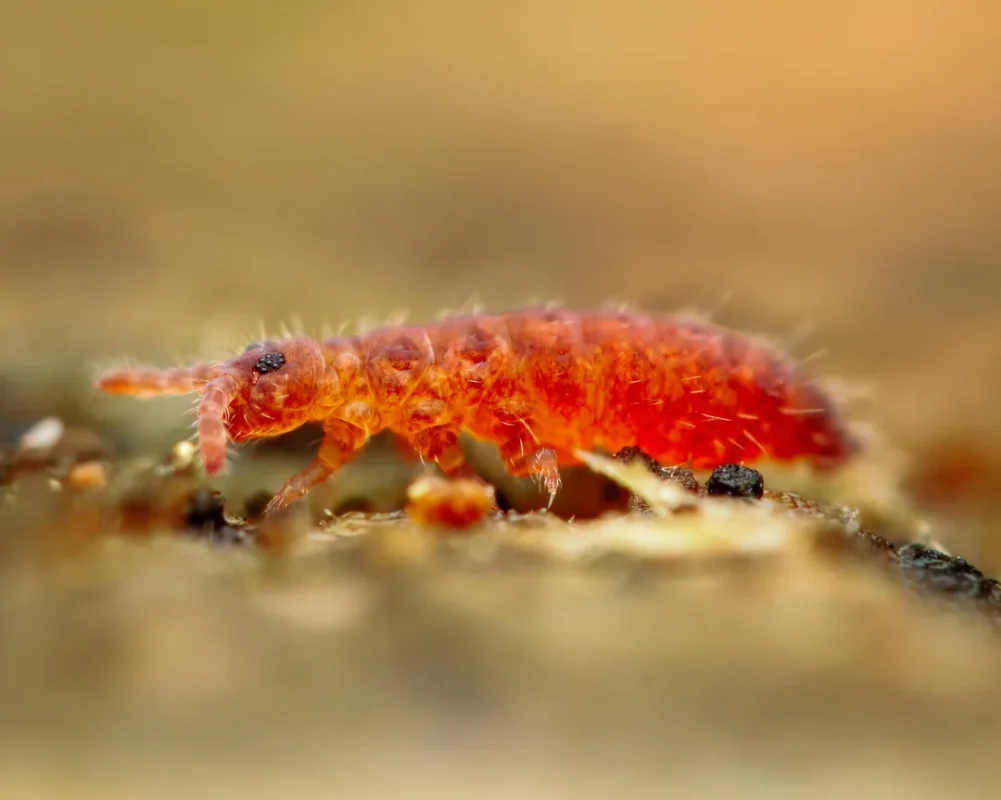
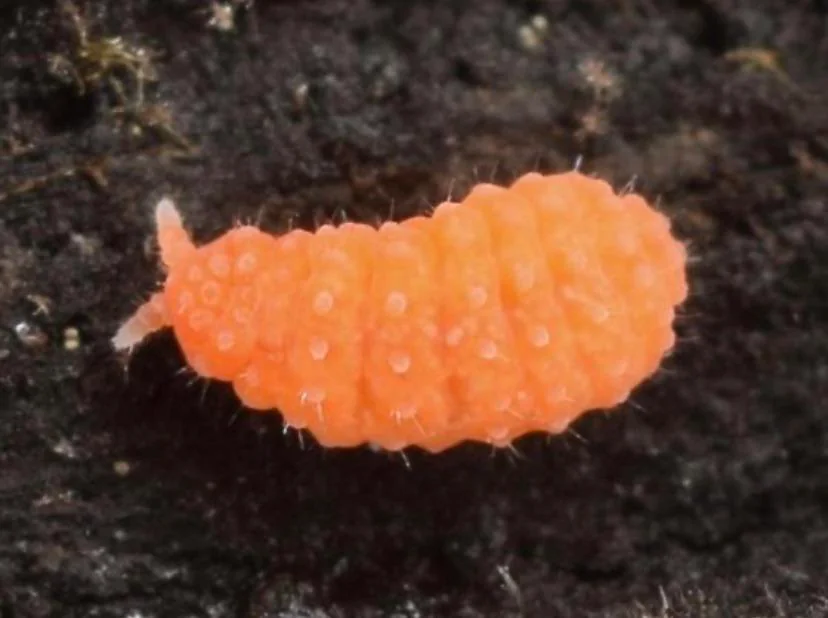
- Florida Orange (Neanura growae) — slow-moving, non-jumping, very visible — stimulating prey for dart frogs
We recommend seeding your vivarium 3–5 weeks before introducing frogs to allow the colony to reach functional density first.
Yes — multiple species can absolutely coexist in the same enclosure and this is actually encouraged for complete cleanup crew coverage. Different species occupy different substrate layers and ecological niches, so they complement rather than compete with each other.
For example: Folsomia candida works deep in the soil, while surface-active species like Orchesella cincta or Coecobrya tenebricosa handle the litter layer and visible substrate zones. Together they cover every level of the enclosure.
Isotoma viridis (Green Springtail) is our top recommendation for moss terrariums — it’s naturally found in moist, moss-rich habitats and its vivid green colouration makes it the most ecologically appropriate and visually complementary species for a moss build.
Pair with Folsomia candida for deep-soil coverage and Hypogastrura vernalis if your setup runs cool and damp. Together they cover every microhabitat a moss terrarium creates.
Our rarest collector species, in order of care difficulty and rarity:
- Tomocerus sp. “Blue” (Iridescent Blue) — our crown jewel; giant, structurally iridescent blue, advanced care
- Tomocerus minor/vulgaris (Iridescent Silver) — same genus as the Blue, equally stunning, advanced care
- Lobella cf. sp. “Thai Red” — vivid red, non-jumping, tropical; introduced to the hobby in 2021
- Lepidocyrtus sp. “Devils Hole” — rare collector surface runner, intermediate care
We recommend having experience with at least one intermediate species before moving to advanced collector cultures.
We specialise exclusively in springtails at Springtails Culture. For isopod pairings, we recommend sourcing from a dedicated isopod supplier — many of our product descriptions include specific isopod pairing suggestions to help you build a complete cleanup crew from the best available sources.
Culture Care
Open your culture immediately after it arrives. Place it at room temperature out of direct sunlight and allow it to settle for 2–4 hours before checking activity. If you’re seeding a vivarium right away, simply place the culture container inside the enclosure, remove the lid, and tap gently — the springtails will disperse into the substrate on their own.
If you’re holding the culture before seeding, store it in a stable temperature environment matching the species’ preferred range and feed lightly once per week.
The most effective and widely available springtail foods are:
- Brewer’s yeast — the hobby standard; sprinkle a small amount on the substrate surface
- Tropical fish flakes — universally accepted by nearly all species
- Dried mushroom / spirulina — excellent for protein-hungry species like Thai Red
- Small amounts of boiled rice — particularly good for orange Neanura species
The most important rule: feed small amounts regularly rather than large amounts infrequently. Excess food in a warm, sealed culture can cause CO₂ buildup and crash a colony very quickly.
The most common reasons a culture fails to reproduce are:
- Wrong temperature — the single biggest factor; check your species’ preferred range and match it
- Substrate too dry — springtails need consistent moisture; drying out even briefly can suppress reproduction
- Not enough food — underfed colonies stop reproducing before they die; feed more consistently
- Too much food — paradoxically, excess food causes CO₂ buildup that suppresses reproduction
- Wrong substrate — some species have specific substrate requirements (Thai Red needs organic soil only, not charcoal)
The simplest test is the blow test — gently blow on the substrate surface. Active springtails will respond to the CO₂ in your breath and move. If you see movement, the colony is alive and active.
The food test also works well: place a small piece of fish flake or yeast on the substrate surface. If the colony is healthy and hungry, springtails will swarm the food within a few hours. No activity after 24 hours suggests a struggling or crashed colony.
Most springtail species can technically escape through small gaps — jumping species (Tomocerus, Entomobrya) particularly so. However, in practice, springtails that escape a warm, humid vivarium into a dry room environment will desiccate quickly and die.
The exception is non-jumping species like Florida Orange (Neanura growae) and Thai Red (Lobella cf.) — these are much easier to contain as they lack the furcula that allows jumping.
For jumping species, ensure your enclosure has a well-fitted lid and leave at least 1.5 inches of clearance at the top of standalone culture containers.
Most species take 3–6 weeks to reach a functional cleanup crew density in a new vivarium, depending on temperature, substrate quality, and available food. This is why we recommend seeding 3–5 weeks before introducing animals — it gives the colony time to establish before the organic load of a live animal is added.
At optimal temperatures, prolific species like Folsomia candida and Coecobrya tenebricosa can reach visible colony density in as little as 2–3 weeks.
Ordering & Payment
We accept all major credit and debit cards, PayPal, and any payment methods supported by our checkout platform. All transactions are processed securely — we never store your payment details.
If you need to change or cancel your order, contact us immediately after placing it. We process and pack orders quickly — if your order has already been prepared for shipping, changes may not be possible. We’ll always do our best to accommodate requests made promptly.
Yes — our 1,000-count quantity options represent our best wholesale pricing per springtail across all species. If you’re interested in larger wholesale arrangements, bulk pricing for multiple species, or a regular supply agreement, get in touch with us directly and we’ll discuss what’s possible.
All sales of live animals are final — we cannot accept returns of live cultures once they have been shipped. This is standard practice across the live animal industry and is why we back every order with our live arrival guarantee instead.
If something goes wrong with your order, our guarantee covers you — contact us within 24 hours of delivery and we will make it right.
Yes — we raise all our cultures in-house and restock regularly. Because some of our rarest species have naturally limited availability, stock can sell out quickly. The best way to stay informed about restocks is to subscribe to our newsletter — we announce new stock, new species, and restocks there first before anywhere else.
You can also contact us directly to ask about availability or expected restock timing for a specific species.
Use our contact page and we’ll get back to you as quickly as possible. We’re a solo operation so response times are typically within 24–48 hours on business days. For the fastest response, include your order number if your question is about an existing order.
Still have a question?
We’re a solo operation — real answers from the person who raises these animals every day.