
Species Guides
McDo vs Santa Claus Springtails: What’s the Difference?

Nov
Short answer: McDo and Santa Claus springtails are two different red Philippine springtails in the family Neanuridae. McDo is red with a bold yellow pattern and is large, reaching roughly 3 to 5 millimeters. Santa Claus is red and white. Both are slow, cannot be treated like ordinary springtails, and feed on live slime mold. If you want the bigger, higher-contrast animal, choose McDo. If you want a festive, more affordable way into collector springtails, choose Santa Claus. Care is very similar, but keep the two in separate containers.
People mix these two up all the time, and the confusion is understandable: both are red, both come from the Philippines, both are Neanuridae and both are sold by the same small group of breeders. This guide explains how to tell them apart, how they are alike, how to care for them and which one to buy first.
Table of Contents
McDo vs Santa Claus springtails at a glance
| Feature | McDo | Santa Claus |
|---|---|---|
| Family | Neanuridae | Neanuridae |
| Origin | Philippines | Philippines |
| Look | Red body with a bold, contrasting yellow pattern | Red and white |
| Size | Large, roughly 3 to 5 mm | Check the listing for the size you receive |
| Body texture | Fleshy bumps (tubercles) | Neanuridae body form, with a soft, bumpy look |
| Jumping | Cannot jump | Cannot jump, like other Neanuridae |
| Food | Live slime mold | Live slime mold |
| Dry food (yeast, flakes) | No | No |
| Keep with fast springtails? | No, in a small culture | No, in a small culture |
| Our listing | See rare and exotic springtails | Santa Claus springtails |
What they have in common: the Neanuridae
To understand both animals, you need to understand the family they belong to. Neanuridae are a group of springtails that are quite unlike the tiny, jumping species most keepers know. Over a long evolutionary path, they changed in several ways.
They have lost the jump
The name “springtail” comes from a forked tail-like organ, the furca, that most species flick against the ground to launch themselves. Neanuridae have lost it. They walk slowly and deliberately, and they will not leap out of a container when you open the lid. That makes them calm to keep and easy to watch.
They are chunky and colorful
Instead of a smooth, fragile body, Neanuridae have sturdy, bumpy bodies, and many species carry bright red, orange or yellow coloring. Bright colors in nature often warn predators that an animal is unpleasant to eat, a trait called aposematism. In your terrarium, it simply means they are some of the easiest springtails to spot.
They feed on slime mold
This is the most important shared trait. Neanuridae have lost their biting mouthparts. What remains resembles a piercing and sucking probe, used to puncture a cell and drink the contents. They cannot eat flakes, pellets, yeast powder or dry leaves. They feed on the liquid inside live slime mold. We explain how this works in detail in our guide to slime mold for springtails.
McDo springtails
McDo springtails come from the humid rainforests of the Philippines, and they have become one of the most desirable display springtails in the hobby. Breeders know them by the nickname McDo. They are an absolute standout.
What they look like
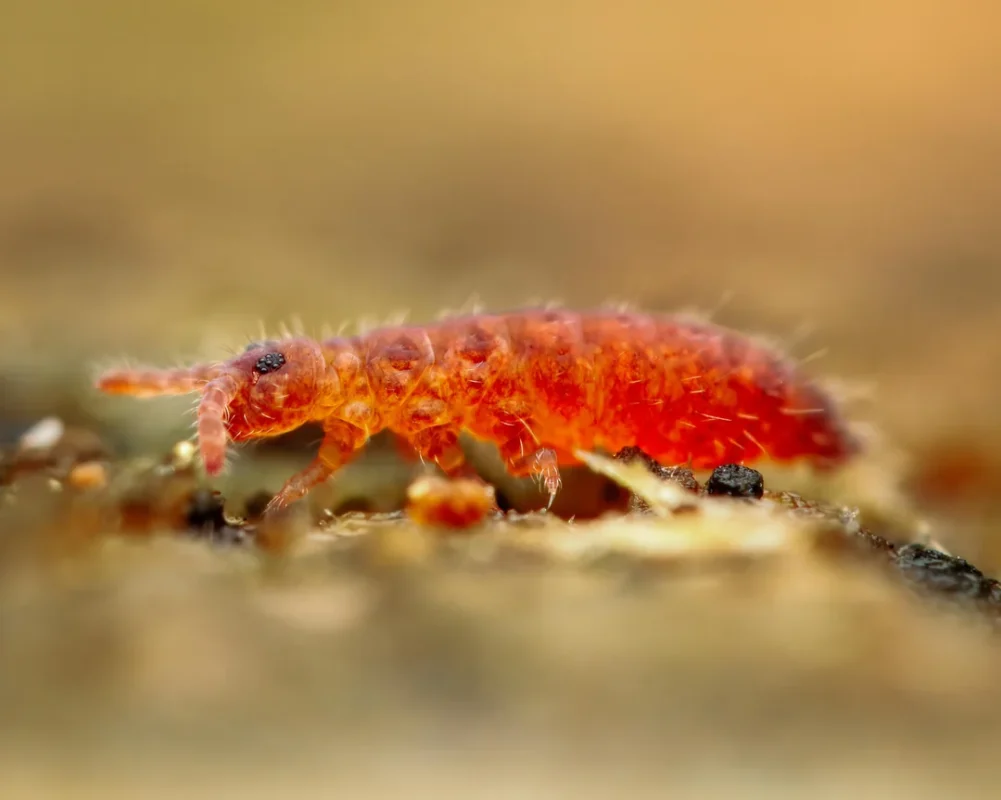
McDo are red with a beautiful, highly contrasting yellow pattern. Their bodies are covered with fleshy bumps. They are noticeably big for springtails, growing to roughly 3 to 5 millimeters, so you can see them with the naked eye and watch them move across moss and bark. That contrast is the McDo’s calling card, and it is the main way to recognize one.

How they behave
McDo move slowly and will not jump. They cluster on food, drink from slime mold and tend to stay near damp, sheltered spots. A healthy colony is easy to observe, which makes McDo a favorite for display enclosures.
Reported growth
One breeder reports taking a group of ten adults to roughly a thousand animals in two to three months under ideal conditions. Treat that as a best case. Growth depends on food, moisture, temperature and the quality of the slime mold.
Who they suit
McDo suit keepers who want a showpiece and are comfortable feeding slime mold. They are not difficult once you understand their diet, but they are not a “set and forget” species.
Santa Claus springtails
Santa Claus springtails, also sold as Redford White, are another Philippine Neanuridae. Their red and white coloring gives them a festive look, and the name has made them a seasonal favorite.
What they look like
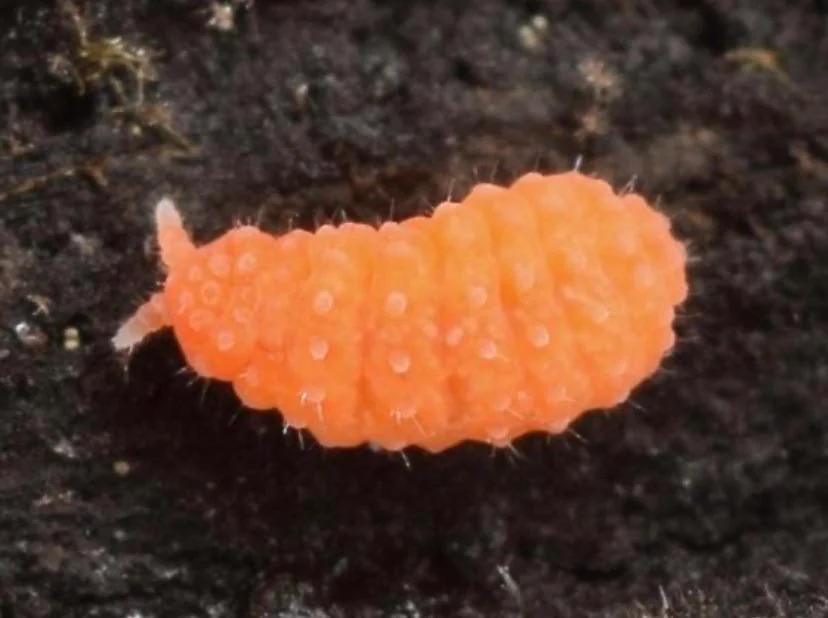
As the name suggests, they are red and white. They stand out clearly against moss, dark soil and bark, and they look striking in a display. Because sellers sometimes label other red springtails with similar names, always check the listing and the photos.

How they behave
Like McDo, Santa Claus are slow, calm and unable to jump. They cannot eat hard or dry food and need access to slime mold. Breeders also advise against keeping them in a small container with aggressive, fast-growing springtails such as Folsomia candida, because those species can outcompete them for food.
Who they suit
Santa Claus is a good way into collector springtails. Our packs of ten cost less to start with than many rare species, and they make an appealing gift. See the Santa Claus springtails page for current options.
The main differences
- Color pattern. McDo is red with yellow. Santa Claus is red and white. If you can see the pattern clearly, this is the easiest way to tell them apart.
- Size and presence. McDo is large and dramatic, up to about 5 millimeters. Check the size of the Santa Claus you receive, since sizes vary by age.
- Price and entry point. Santa Claus is usually the more approachable starting point, and McDo is often the showpiece purchase. Check each page for current prices.
- Reputation. McDo is widely known by its nickname and treated as a flagship display species. Santa Claus has a seasonal, gift-friendly appeal.
- Seller naming. McDo is a fairly consistent name. Santa Claus and Redford White are often used for the same or similar animals, and other red Philippine springtails have their own names. Always confirm with the seller.
Everything else, including diet, moisture, handling and tank mates, is nearly identical.
Shared care: what both need
You can use the same basic method for both. The details below reflect methods that experienced breeders report using. Adjust them if your own animals tell you otherwise, and always follow the care sheet that comes with your order.
Food: live slime mold
Offer a small piece of live, gentle slime mold on a clean feeding spot. Breeders report that feeding at least once every two weeks is the bare minimum, and more often is better, especially while the colony grows. Remove old, dry or moldy pieces. You can buy live slime mold alongside your springtails.
Container and substrate
A container of about 350 milliliters or more, with at least 2 centimeters of plain, chemical-free soil, is enough for a starter colony. Some breeders scald or bake the soil first to remove wild mites.
Moisture
Keep the substrate damp throughout, but never flooded. These animals can suffocate in standing water, and slime mold does not survive well when everything is soaked. The soil should never be bone dry either.
Ventilation
Some breeders keep small colonies in sealed containers with little ventilation, because holes dry the substrate quickly and drying is a common cause of collapse. If you see condensation or runaway mold, add a little airflow. As the colony grows, ventilation matters less.
Temperature
Both are tropical. Keep them at comfortable room temperature, out of direct sun and away from cold windows and heaters.
Starting numbers
About ten adults is enough to start. Place them gently on the surface and give them food straight away.
Our guide on feeding McDo and Santa Claus with slime mold goes through each step, including a 12-week plan, gut loading and troubleshooting.
Which one should you buy?
Choose McDo if you want…
- The biggest, most dramatic display springtail.
- A red and yellow pattern that stands out.
- A colony that is easy to watch because of its size.
Choose Santa Claus if you want…
- A more affordable first collector springtail.
- A festive red and white look, perfect for the holidays.
- A gift that is rare but approachable.
Choose both if you…
- Enjoy collecting and have separate containers and slime mold ready.
- Want to compare the two side by side.
Buy them as a gift?
Both make memorable gifts for keepers who already enjoy rare animals, but they are best for people with some experience, because of the slime mold requirement. Include slime mold in the order, and tell the recipient how to use it. Our gift guide has a complete plan for this, and our gift sets include collector springtail options.
The naming confusion
The collector springtail hobby uses nicknames, and different sellers sometimes use the same name for different animals. That is why this question comes up so often.
- McDo is a Philippine Neanuridae, red with a yellow pattern.
- Santa Claus is a Philippine Neanuridae that is red and white, also sold as Redford White.
- Other names, such as Jollibee and Thai Red Spiky, are used for other species. Breeders caution that these are completely different animals from McDo.
To avoid disappointment:
- Compare the photos on the listing with the animals you want.
- Ask the seller which species they are selling and where it comes from.
- Look for a description of the pattern and size, not only a name.
- Keep each culture labeled once you receive it.
If you are unsure what you want, contact us with a photo or a description, and we will help you choose.
Can you keep them together?
In theory, two slow Neanuridae with similar needs can share a large enclosure. In practice, we recommend separate cultures for three reasons.
- Mix-ups. If you ever want to sell, share or track a line, mixed colonies become impossible to untangle.
- Competition. Both feed from the same slime mold, and a crowded food source can leave the smaller group short.
- Troubleshooting. If a colony struggles, it is far easier to diagnose when it is alone.
Neither should be kept in a small culture with fast springtails such as white springtails. They are likely to be outcompeted. In a large, established vivarium, different species use different layers, so mixing is less of a problem. For a standard clean-up crew, see our guides to setting up a bioactive terrarium and springtails vs isopods.
Frequently asked questions
Are McDo and Santa Claus springtails the same?
No. They are different species, though both are red Philippine Neanuridae. McDo is red with a yellow pattern, and Santa Claus is red and white.
Which is bigger, McDo or Santa Claus?
McDo is noted for its large size, roughly 3 to 5 millimeters. Check the size of the Santa Claus on the listing, since sizes vary by age.
What do McDo and Santa Claus eat?
Both feed on live slime mold. They cannot eat flakes, yeast or dry leaves, because their mouthparts are built for piercing and sucking.
Can they jump?
No. Like other Neanuridae, they have lost the jumping organ, so they move slowly and will not leap out of a container.
Which is easier to keep?
They are very similar in care. Both need live slime mold, damp substrate and protection from fast, aggressive springtails. Neither is as forgiving as a common white springtail.
Which is cheaper?
Santa Claus is usually the more affordable starting point. Check the current prices on each page.
Is Santa Claus the same as Redford White?
Sellers often list Santa Claus under the name Redford White. Always confirm with the seller and compare photos.
Can I keep them with white springtails?
We advise against it in a small culture, because fast white springtails can outcompete them. In a large, established enclosure, it is less of a problem.
How many should I start with?
About ten adults is enough for a small starter culture, and our Santa Claus packs come in tens.
Do I need slime mold?
Yes. It is the essential food. You can buy live slime mold from us.
Are they good for a vivarium?
They are best as display microfauna because they are colorful, slow and easy to see. For a full clean-up crew, you will still want common springtails and isopods. See our guide to the best isopods for beginners.
The bottom line
McDo and Santa Claus are close cousins with nearly identical care, and the main differences are looks and price. McDo is the bigger, red-and-yellow showpiece. Santa Claus is the festive red-and-white starter. Whichever you choose, give them live slime mold, damp but never flooded soil and a container of their own, and you will have one of the most striking microfauna colonies in the hobby.
Questions? Read our FAQ, see How It Works or contact us.
Shop Santa Claus springtails | Shop rare springtails | Shop slime mold
