
Buying Guides
How Many Springtails To Buy? The Complete Guide
Apr
Table of Contents
Published by Springtails Culture · New Baden, Illinois
How Many Springtails To Buy? The Complete Seeding Guide for Every Vivarium Size
It’s one of the most common questions from first-time vivarium builders, and it deserves a proper answer: how many springtails do you actually need to seed a vivarium, and how many cultures should you order?
The vague advice you’ll find most places — “add some springtails and see how it goes” — isn’t useful when you’re deciding between a 50-count starter culture and a 200-count order. Get too few and the colony can’t establish fast enough to stay ahead of mold. Get too many and you’ve spent more than you needed to. There’s a middle ground, and it’s more calculable than most guides suggest.
This is the complete seeding guide: quantities by tank size, factors that affect how many you need, timing rules that most keepers get wrong, and exactly what to order for your specific setup.
The Short Answer — How Many Springtails Do You Need?
If you just need a quick number before reading further:
A healthy starting colony is usually between 10–50 springtails per gallon of terrarium volume — but for most practical purposes, a simpler rule works well:
- Small enclosure (under 10 gallons) → 50 springtails (1 starter culture)
- Medium enclosure (10–20 gallons) → 100–150 springtails
- Large enclosure (20–40 gallons) → 200–250 springtails
- Extra large enclosure (40+ gallons) → 300–500 springtails
- Multiple enclosures → 500–1,000 springtails
Now for the full explanation of why these numbers work and what changes them.
Why Getting the Quantity Right Matters
Springtails are a self-regulating population — they reproduce to match available food and space, and decline when resources are depleted. This means the vivarium eventually reaches its own equilibrium regardless of your starting quantity. But the starting quantity determines how quickly that equilibrium is reached and whether your vivarium is protected during the critical early period.
Too few springtails: The colony takes too long to establish. Mold outbreaks can occur during the gap between seeding and functional colony density — especially in warm, humid tropical setups where mold pressure is highest.
Too many springtails: Not actually harmful — springtails won’t damage your vivarium, plants, or animals regardless of population density. The excess simply die off as the colony self-regulates. You’ve spent more than necessary, but there’s no downside beyond cost.
The right starting quantity: Enough individuals to establish functional mold-control density within 3–5 weeks, before your first animals go in.
The Seeding Calculator — By Tank Size
Use this table as your starting point. These are recommended starting quantities for a standard tropical or temperate bioactive setup:
| Tank Size | Gallons | Springtails Needed | Cultures to Order |
|---|---|---|---|
| Nano / pico (e.g. 2.5 gal) | Under 5 gal | 50 | 1 × 50-count |
| Small (e.g. 10 gal) | 5–10 gal | 50–100 | 1 × 50 or 1 × 100-count |
| Medium (e.g. 18×18×24) | 10–20 gal | 100–150 | 1 × 100 or 1 × 150-count |
| Large (e.g. 24×18×36) | 20–40 gal | 200–250 | 1 × 200 or 1 × 250-count |
| Extra large (40+ gal) | 40–75 gal | 300–500 | 1 × 500-count |
| Multiple enclosures / colony | — | 500–1,000 | 1 × 500 or 1 × 1,000-count |
A single culture can seed 3–4 small enclosures (up to 12″×12″), 2–3 medium enclosures (up to 18×18), or a single larger enclosure — so if you’re setting up multiple vivariums simultaneously, ordering a higher quantity culture is significantly more economical than ordering multiple small cultures.
Factors That Affect How Many You Need
The table above assumes a standard setup. Here are the factors that push your quantity up or down:
Factor 1 — Animal Load
The more animals in your vivarium, the more organic waste they produce, and the harder your springtail colony has to work. A heavily stocked dart frog vivarium needs more springtails than a lightly planted terrarium with no animals.
Rule of thumb: Add 25–50% more springtails than the base quantity for the tank size if you’re housing animals from day one or stocking heavily.
Factor 2 — Plant Density
Terrariums with a dense plant population produce more decaying organic matter, necessitating a larger springtail colony — but a heavily planted vivarium also provides more microhabitats for the colony to establish in, which accelerates population growth.
If your setup features live tropical plants from Variegated Plant Shop or another quality supplier, expect higher organic turnover as plants shed leaves and shed root material — which is a benefit for springtail colony development, not a concern.
Factor 3 — Substrate Depth and Type
Deeper substrate provides more habitat for springtail colonies to establish. A vivarium with 3 inches of substrate supports a larger, more stable population than one with 1 inch. Organic soil substrates support larger colonies than charcoal or clay.
Shallow substrate: Add 25% more springtails to compensate for reduced habitat depth. Deep organic substrate (3+ inches): Standard quantities are fine — the substrate supports rapid colony establishment.
Factor 4 — Temperature
Warmer temperatures accelerate springtail reproduction significantly. A tropical vivarium at 26°C will see colony establishment much faster than a temperate build at 18°C.
Tropical setups (22–28°C): Standard quantities — fast reproduction compensates quickly. Temperate setups (15–20°C): Add 25–50% more than the base quantity to account for slower reproduction rate. Cold setups (below 15°C):Consider doubling the base quantity — very slow reproduction at cold temperatures.
Factor 5 — Presence of Isopods
Isopods and springtails complement each other ecologically and can coexist in the same vivarium without competition. However, isopods handle macro-waste while springtails handle micro-waste — they are not interchangeable. Having isopods present does not reduce the number of springtails you need.
Factor 6 — New vs Established Vivarium
A brand new vivarium with no organic history needs more springtails than one that has been running for several months with some existing microbial activity. For brand new builds, always use the higher end of the quantity range.
The Most Important Timing Rule
Getting the quantity right matters far less than getting the timing right. This is where most keepers make their biggest mistake:
Ideally, springtails should be introduced to a live vivarium 3–5 weeks before adding inhabitants.
That 3–5 week window is non-negotiable for best results. Here’s why it matters so much:
Week 1–2: Springtails distribute through the substrate, locate food sources, and begin reproducing. The colony is below functional density — not yet capable of keeping up with significant mold pressure.
Week 2–4: Population grows rapidly as juveniles mature. The colony reaches functional cleanup density. Mold is being actively controlled.
Week 4–5: Colony is established at a stable, self-regulating population. This is when your first animals can safely go in.
A common mistake is adding springtails after the reptile keeps pooping. This leads to mold outbreaks because the cleanup crew hasn’t established.
If you’ve already introduced animals before seeding — which happens often with new keepers — don’t panic. Add springtails now and give them 2–3 weeks to catch up. In the meantime, remove any visible mold manually to reduce the load while the colony establishes.
How Many Cultures to Order
Here’s how to translate springtail quantities into actual culture orders from our shop:
For a Single Vivarium
| Your Tank | Order This |
|---|---|
| Nano tank under 5 gallons | 50 springtails — any species from $15 |
| 10-gallon standard | 100 springtails |
| 18×18×24 dart frog viv | 150 springtails |
| 24×18×36 large build | 200–250 springtails |
| 36×18×36 extra large | 500 springtails |
For Multiple Vivariums
If you’re setting up more than one enclosure at the same time, buying a single larger quantity culture is always more economical than buying multiple small cultures:
- 2–3 medium vivariums → 1 × 250-count culture, divided between enclosures
- 3–5 small vivariums → 1 × 500-count culture
- 6+ vivariums or ongoing feeder supply → 1 × 1,000-count culture
Mixed Species Approach
For a complete, layered cleanup crew, consider ordering two complementary species:
- Folsomia candida × 50 for deep soil coverage + Tropical Pink Large Form × 50 for surface coverage = full substrate depth covered from 100 total springtails
Seeding for Different Vivarium Types
Dart Frog Vivariums
For planted terrariums, add approximately 300 springtails and 20 adult isopods to a 10 gallon enclosure containing 2–3 inches of substrate.
Dart frog vivariums need higher starting quantities than standard terrariums because:
- The organic load from dart frogs is significant relative to their body size
- Springtails serve a dual feeder role — colonies are partially consumed by frogs, reducing steady-state population
- High humidity creates higher mold pressure requiring a larger active colony
Recommended: Use the higher end of the quantity range for your tank size and add a second species for layered coverage.
Best species for dart frog vivariums:
- Tropical White Springtails — deep substrate coverage, fast-reproducing feeder colony
- Tropical Pink Large Form — larger body, more substantial prey for adult frogs
- Florida Orange Springtails — vivid, visible feeder prey, non-jumping and easy for frogs to catch
Moss Terrariums
Moss terrariums run cool and damp — conditions that slow springtail reproduction compared to tropical setups. Compensate by starting with 25–50% more springtails than the base quantity for your tank size.
Best species for moss terrariums:
- Isotoma viridis Green Springtails — naturally found in moss-rich moist habitats, vivid green, the definitive moss terrarium species
- Folsomia candida — wide temperature tolerance, reliable in cool conditions
- Hypogastrura vernalis Spring Springtails — cold-adapted specialist for the coolest, dampest setups
Reptile Bioactive Enclosures
Reptile enclosures generate significant organic waste relative to their size — especially for larger animals. Use the higher end of the quantity range and consider a second species for depth coverage.
Best species for reptile bioactive setups:
- Folsomia candida — the most reliable all-rounder for any reptile setup
- Tropical White Springtails — for warm tropical reptile enclosures (22°C+)
- Orchesella cincta Banded Springtails — large, visible, surface-active — great for temperate reptile builds
Display / Collector Terrariums
Display vivariums prioritise visual impact alongside function. Choose species based on aesthetics as much as ecological role:
- Cool, moss-rich display → Isotoma viridis (vivid green)
- Warm tropical display → Tropical Lilac + Tropical Yellow for colour diversity
- Collector showcase → Orchesella cincta (bold banding, visible, large)
What Happens After You Seed
Once your springtails are in, here’s the typical establishment timeline:
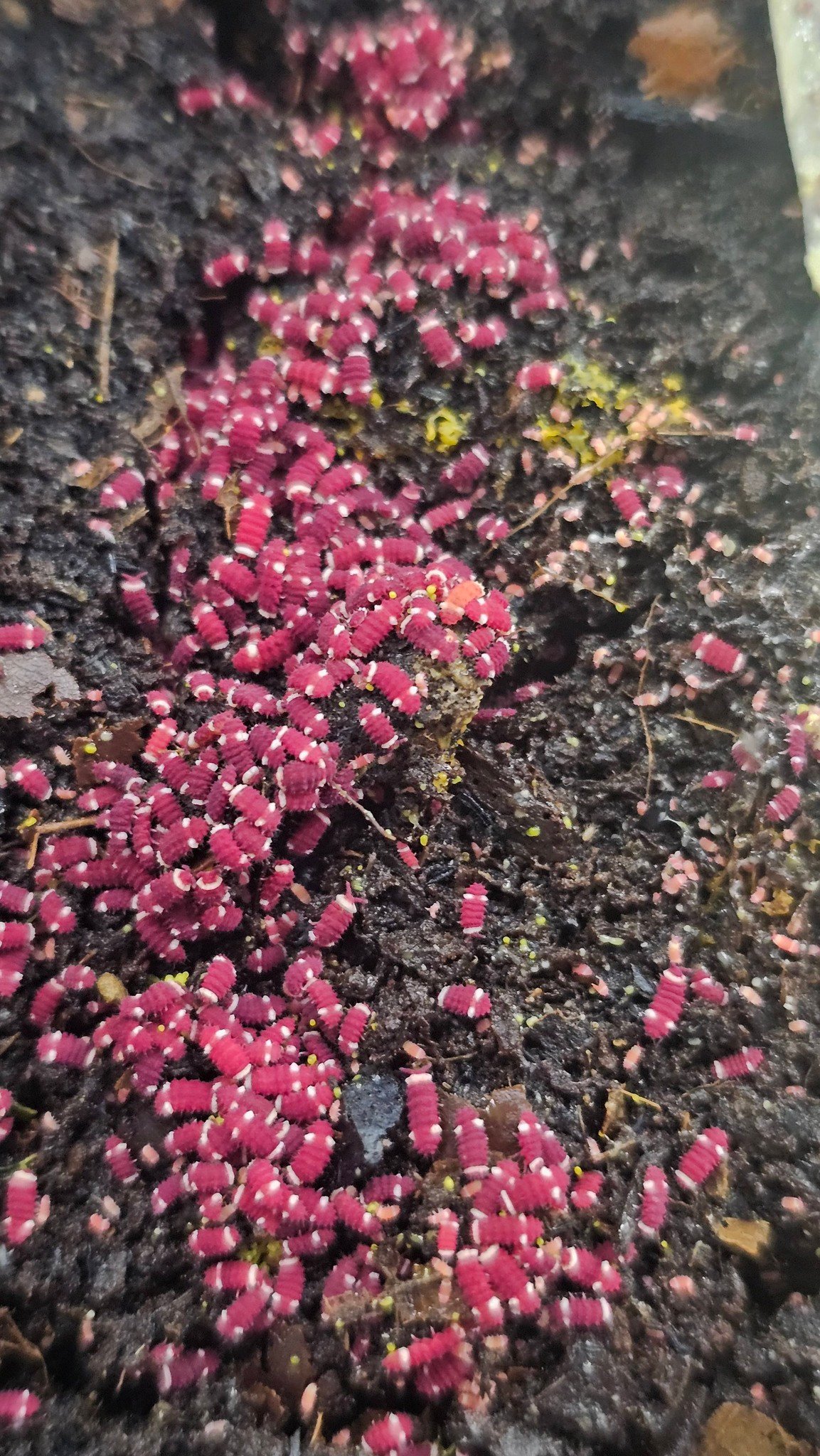
Days 1–7: Springtails distribute through the substrate. You may see them initially then they disappear underground — this is normal. They are photophobic and prefer dark, moist substrate layers.
Days 7–14: Reproduction begins. Eggs are laid in the substrate. Ghost feed lightly once per week — a small pinch of brewer’s yeast or fish flake on the substrate surface. This supports the colony during establishment without overfeeding.
Days 14–28: Juveniles mature and the colony grows visibly. Feeding swarms appear on food sources. The colony is reaching functional density.
Days 28–35: The colony is established. Full mold-control capacity is reached. This is when animals can safely be introduced.
Beyond day 35: The colony self-regulates. In a vivarium with animals, no supplemental feeding is needed — the organic load of the animals provides sufficient food. The population stabilises at whatever density the enclosure can support.
Do You Ever Need to Top Up?
In most cases, no. Once springtails are introduced into a properly built enclosure, they will likely never need to be re-introduced, and will sustain themselves for the life of the vivarium.
The exceptions where top-ups are justified:
- Heavy dart frog predation: If frogs are consuming springtails faster than the colony reproduces, add a fresh culture. This is most common with adult dart frogs in small vivariums.
- Colony crash: If something has disrupted the colony (substrate dried out, extreme temperature event, pesticide contamination), add a fresh culture to re-establish.
- New vivarium sections: If you’re extending or significantly expanding a vivarium, add a culture to the new area.
Shop by Quantity — Finding the Right Culture Size
All Springtails Culture products are available in quantities from 50 to 1,000 springtails. Every quantity tier is available on every species — so you’re never forced to buy more or less than your setup needs.
Browse all species and quantities at Springtails Culture →
Not sure which species to choose? Our How It Works guide matches species to setup type in detail. Have a specific question about your enclosure? Contact us directly — we answer every message personally.
FAQ — How Many Springtails Do You Need?
Q: Can I add too many springtails to a vivarium? A: Not really. Springtails self-regulate — the population grows until available food and space are saturated, then stabilises. Excess individuals simply die off naturally as the colony equilibrates. Adding more than you need costs extra money but causes no harm to your vivarium or its inhabitants.
Q: How long does it take for a springtail colony to establish in a vivarium? A: Under optimal conditions — tropical temperatures, moist organic substrate, pre-animal seeding — a colony reaches functional density in 3–5 weeks. At cooler temperatures the timeline extends. Cold setups (below 18°C) may take 6–8 weeks to reach functional density.
Q: I already have animals in my vivarium — is it too late to add springtails? A: No — add them now. They will still establish, just more slowly due to the existing organic load and potential predation pressure. Give them 3–4 weeks to catch up and manually remove any visible mold during that period.
Q: Do I need to remove springtails from their culture container before adding them to my vivarium? A: No. Simply tip the culture contents — springtails and substrate together — into your vivarium and mix lightly into the top layer of your substrate. The culture substrate is compatible with vivarium substrate and the springtails will find their way through on their own.
Q: My springtails disappeared after I seeded — did they die? A: Almost certainly not. Springtails are photophobic and move underground into dark, moist substrate layers where they’re invisible to the naked eye. Use the blow test — gently blow across the substrate surface — to confirm they’re still there. Active springtails will surface in response to CO₂.
Q: How many springtail species should I use in one vivarium? A: One species is sufficient for most setups. Two complementary species — for example, a surface-active species plus a deep-soil species — provide better ecological coverage and are worthwhile for larger or more complex builds. More than two species in one vivarium provides diminishing returns.
Q: Should I buy extra springtails to maintain a culture outside the vivarium? A: Yes — highly recommended. A standalone master culture outside the vivarium gives you a reserve population to top up the vivarium if needed, a feeder supply for dart frogs, and security if anything disrupts the vivarium colony. Order 100–200 extra springtails to establish a standalone culture.
Q: Do different springtail species need different quantities? A: The tank-size quantity guide applies to all species. However, slower-reproducing species (like Thai Red or Iridescent Silver) may benefit from starting with 25–50% more individuals to compensate for the longer establishment timeline.
Summary — The Quick Reference Table
| Setup | Tank Size | Springtails | Species |
|---|---|---|---|
| Nano terrarium | Under 5 gal | 50 | Any beginner species |
| Small planted build | 5–10 gal | 50–100 | Folsomia candida |
| Standard dart frog viv | 10–20 gal | 150–200 | Tropical White + Pink LF |
| Moss terrarium | 10–20 gal | 150 (+25%) | Isotoma viridis |
| Large reptile viv | 20–40 gal | 200–250 | Folsomia candida |
| Extra large viv | 40+ gal | 300–500 | Multi-species |
| Multiple enclosures | — | 500–1,000 | Wholesale quantity |
Order the right quantity for your setup →
All species available from 50 to 1,000 springtails. Shipped Monday–Wednesday via USPS, FedEx, or UPS. Live arrival guaranteed on every order.
New to bioactive setups? Read our How It Works guide for a full walkthrough from choosing your species to seeding your vivarium step by step. Questions about your specific enclosure? Contact us — we answer every message personally from New Baden, Illinois.
