
Species Guides
The Tomocerus Files (Tomocerus springtails) — Giant Iridescent Springtails Guide
Apr
Table of Contents
The Tomocerus Files (Tomocerus springtails) — Everything You Need to Know About Giant Iridescent Springtails
Published by Springtails Culture · New Baden, Illinois
Most springtail species, when placed side by side, look essentially the same. White or pale-bodied, a millimetre or two long, invisible in substrate and anonymous in a culture container. You know they’re working. You rarely see them doing it.
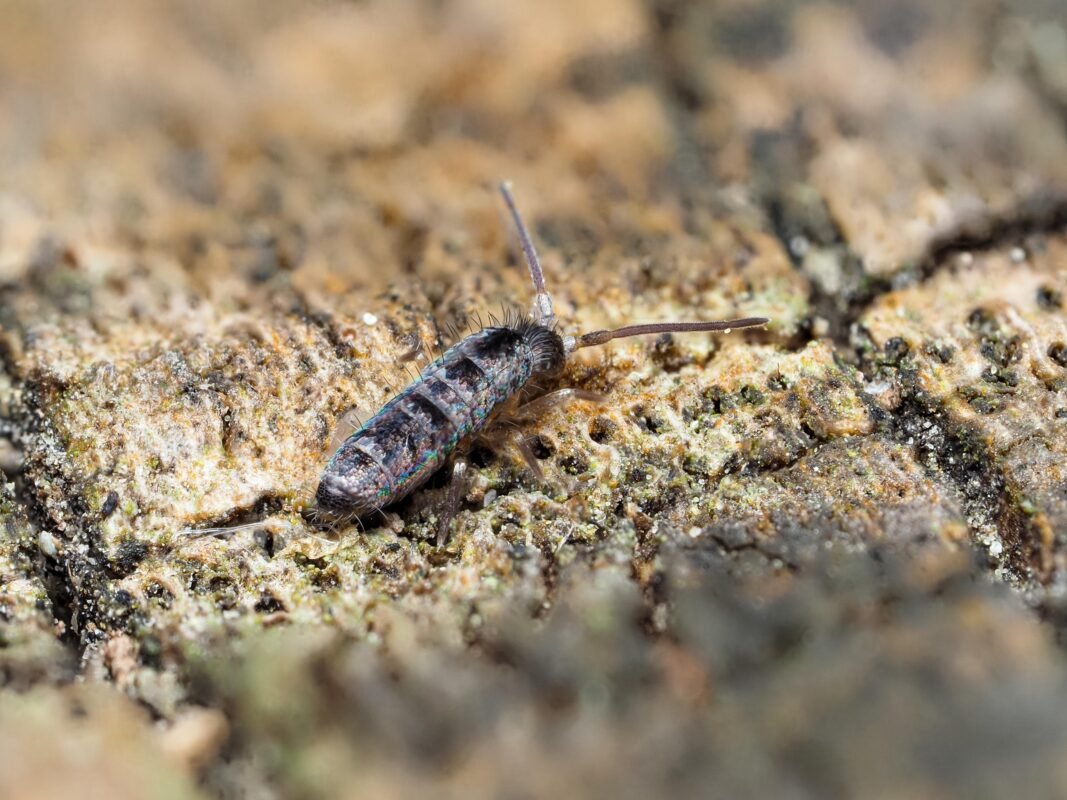
Tomocerus is different. This is the springtail genus that changes what you think a springtail can be — giant in body, iridescent in colouration, active on the surface, and genuinely spectacular to watch. At 4–6mm, a healthy adult Tomocerusis three to four times the size of a standard springtail species. Its body is covered in overlapping dark and metallic scales that produce a shimmering, shifting iridescence that photographs poorly and impresses immediately in person.
Within the Tomocerus genus, three distinct species and variants are available in dedicated culture. Each is different. Each is extraordinary. And all three are available from Springtails Culture — raised in-house in New Baden, Illinois.
This is the complete guide to all of them.
What Are Tomocerus Springtails?
Tomocerus is a genus of large, scale-covered springtails belonging to the family Tomoceridae — one of the most visually distinctive Collembola families in the world. The genus is found naturally across the Northern Hemisphere, from the woodland floors of Europe and North America to the temperate forests of Asia.
They are surface-dwelling detritivores — spending their lives navigating leaf litter, bark surfaces, and the upper layers of organic substrate, feeding on fungal hyphae, decaying plant matter, algae, and bacteria. Unlike many springtail species that disappear underground and are rarely seen, Tomocerus is consistently visible on substrate surfaces, wood, moss, and the litter layer of a vivarium — making every individual’s iridescent colouration available to observe continuously.
Adult silver springtails can really jump — 4–5 inches or more — and can easily escape from a culture container when the substrate is filled to the top. This is an important care consideration — leave at least 1.5–2 inches of empty space at the top of any Tomocerus culture container, and always open cultures over a clean, dry container to catch any individuals that spring during transfers.
The Tomoceridae — A Family Unlike Any Other
Tomocerus belongs to the Tomoceridae — a springtail family defined by one characteristic above all others: scales.
All the Tomoceridae are covered with dark and/or iridescent scales. At least, they start out with scales, but these are easily lost, revealing a golden body colour underneath.
These scales are not decorative. They are the mechanism of the Tomocerus iridescence — overlapping, structured microscopic scales that interact with light to produce colour through physical interference rather than pigmentation. This is the same mechanism that produces colour in butterfly wings, beetle elytra, and hummingbird feathers. The result is colour that shifts as the angle of light changes, creating the living shimmer that makes Tomocerus so visually extraordinary and so difficult to photograph accurately.
The family also includes Pogonognathellus and other large, scale-covered genera — but Tomocerus is the genus most commonly found in hobbyist culture and the most accessible to keepers who want to experience the full spectacular range of what large iridescent springtails can offer.
The Science of Iridescence — Why They Shimmer
Understanding why Tomocerus springtails shimmer the way they do adds genuine depth to keeping them — and helps explain why photographs almost never do them justice.
Tomocerus vulgaris is characterised by transverse iridescent bands of scales in natural light — though these may not be visible with flash photography.
The iridescence is structural — produced by the physical microstructure of the scales rather than by any chemical pigment. Each scale is a microscopic layered structure that reflects different wavelengths of light at different angles. When many scales are packed together across the Tomocerus body in transverse bands, the collective effect is a shimmering, shifting colour impression that changes as the animal moves and as the viewing angle changes.
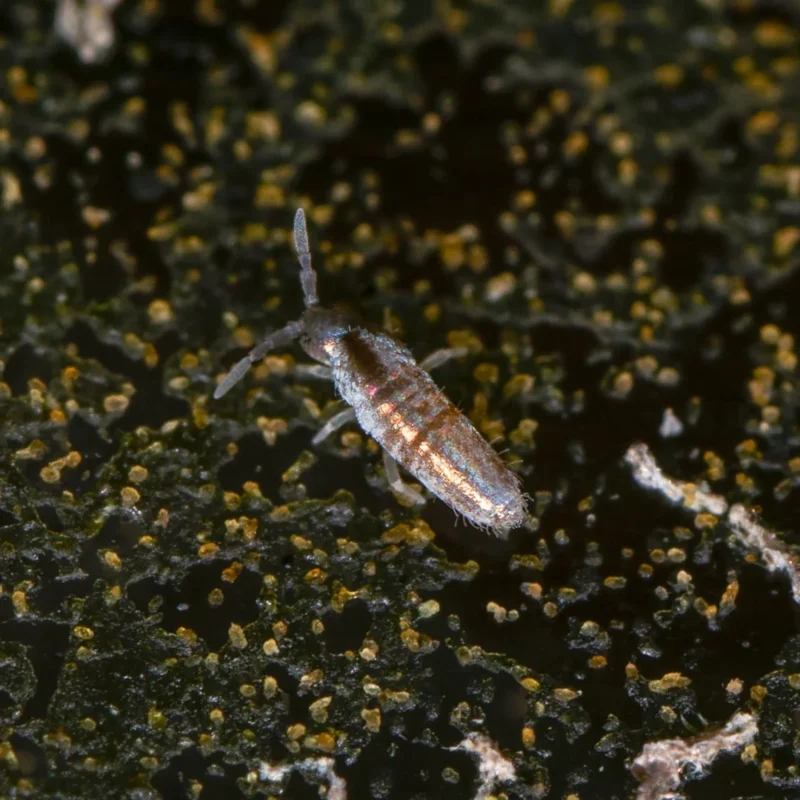
This is why camera flash kills the effect — artificial flash light hits all scales at the same angle simultaneously, washing out the differential reflection that produces the iridescent shimmer. Natural light, particularly bright daylight or LED vivarium lighting, produces the full effect. If you want to see Tomocerus at its best, observe in natural light at multiple angles — and accept that no photograph will fully capture what you’re seeing.
The Three Tomocerus Species in the Hobby
At Springtails Culture, we carry three distinct Tomocerus cultures — each different in colour, thermal adaptation, and intended use:
| Species | Common Name | Size | Colour | Care Level | Best For |
|---|---|---|---|---|---|
| Tomocerus minor/vulgaris | Iridescent Silver | 4–6mm | Silver, blue, purple shimmer | Advanced | Showcase vivariums, collectors |
| Tomocerus sp. “Blue” | Iridescent Blue | 4–6mm | Deep metallic blue | Advanced | Elite collectors, crown jewel culture |
| Tomocerus minor | Large Temperate | Up to 4.5mm | Metallic silvery-blue | Beginner–Intermediate | Woodland vivariums, temperate builds |
Iridescent Silver Springtails — Complete Guide
What It Is
The Iridescent Silver Springtail (Tomocerus minor/vulgaris) is the flagship collector Tomocerus species in the hobby — a giant, surface-active springtail whose scale-covered body shimmers with silver, blue, and purple iridescence in natural light. At 4–6mm, it is one of the largest springtail species available in dedicated culture anywhere in the world.
Its transverse scale bands catch light from multiple angles simultaneously, producing a living shimmer that shifts from cool silver to deep blue to warm purple depending on lighting conditions and viewing angle. This is not a subtle effect — it is immediately visible and immediately impressive to anyone who encounters a healthy adult for the first time.
Performance in a Vivarium
As a surface-active detritivore, the Iridescent Silver navigates the visible substrate surface, leaf litter, bark, and moss of a vivarium continuously — meaning its iridescent colouration is on display throughout its working life rather than hidden underground.
It feeds on:
- Fungal hyphae and mold across substrate and wood surfaces
- Decaying leaf matter and organic material in the litter layer
- Algae, bacteria, and biofilm on substrate and wood surfaces
- Supplemental food: tropical fish flakes, brewer’s yeast
Care Requirements
Tomocerus cultures reproduce well from 45–80°F and survive refrigeration with no problems. Optimal reproduction seems to be between 65–75°F.
| Parameter | Recommended Range |
|---|---|
| Temperature | 18–24°C (65–75°F) — temperate woodland range |
| Humidity | Moderate — damp substrate with moisture gradient |
| Substrate | Organic soil or coconut chips with woody material |
| Diet | Brewer’s yeast, fish flakes, dried leaf material |
| Container | Secure-lidded — leave 1.5–2 inches clearance at top |
| Care Level | Advanced |
Key substrate note: The substrate that works best is the “small” coconut chips available from orchid supply vendors — a porous chunk of cork bark laid on top of the substrate and tapped into the vivarium or a new culture when the springtails have colonised it.
Buy Iridescent Silver Springtails from Springtails Culture → From $35.00 for 50 springtails. Advanced care. Raised in-house in New Baden, Illinois.
Iridescent Blue Springtails — Complete Guide
What It Is
The Iridescent Blue Springtail (Tomocerus sp. “Blue”) is the crown jewel of the Tomocerus genus — and, many collectors would argue, the crown jewel of the entire springtail hobby. Same giant 4–6mm body form as the Iridescent Silver. Same structural iridescence mechanism. Completely different colour expression.
Where the Silver shimmers with warm and cool tones across the full iridescent spectrum, the Blue skews decisively toward the blue end — producing a deep, shifting metallic blue sheen that is unlike anything else in the hobby. It is one of the most photographically challenging subjects in the entire vivarium world — the structural iridescence shifts so actively with viewing angle that no static image captures it faithfully. The real animal always exceeds any photograph of it.
Ultra rare in dedicated culture. Genuinely difficult to source outside specialist suppliers. The culture that experienced collectors add last — because it is the best.
How It Differs From the Iridescent Silver
Both species share:
- Giant 4–6mm body size
- Scale-covered Tomoceridae body
- Structural iridescence from transverse scale bands
- Advanced care requirements
- Surface-active vivarium behaviour
- Identical ecological function
The Blue differs in:
- Colour expression — deep metallic blue rather than silver/multi-tone shimmer
- Rarity — significantly rarer in dedicated culture than the Silver
- Price — commands a premium reflecting genuine rarity and collector demand
Care Requirements
Identical to the Iridescent Silver. Same temperature range, same substrate preference, same feeding regime, same container requirements.
| Parameter | Recommended Range |
|---|---|
| Temperature | 18–24°C (65–75°F) |
| Humidity | Moderate — damp substrate with moisture gradient |
| Substrate | Organic soil or coconut chips with woody material |
| Diet | Brewer’s yeast, fish flakes, dried leaf material |
| Container | Secure-lidded — 1.5–2 inches clearance at top |
| Care Level | Advanced |
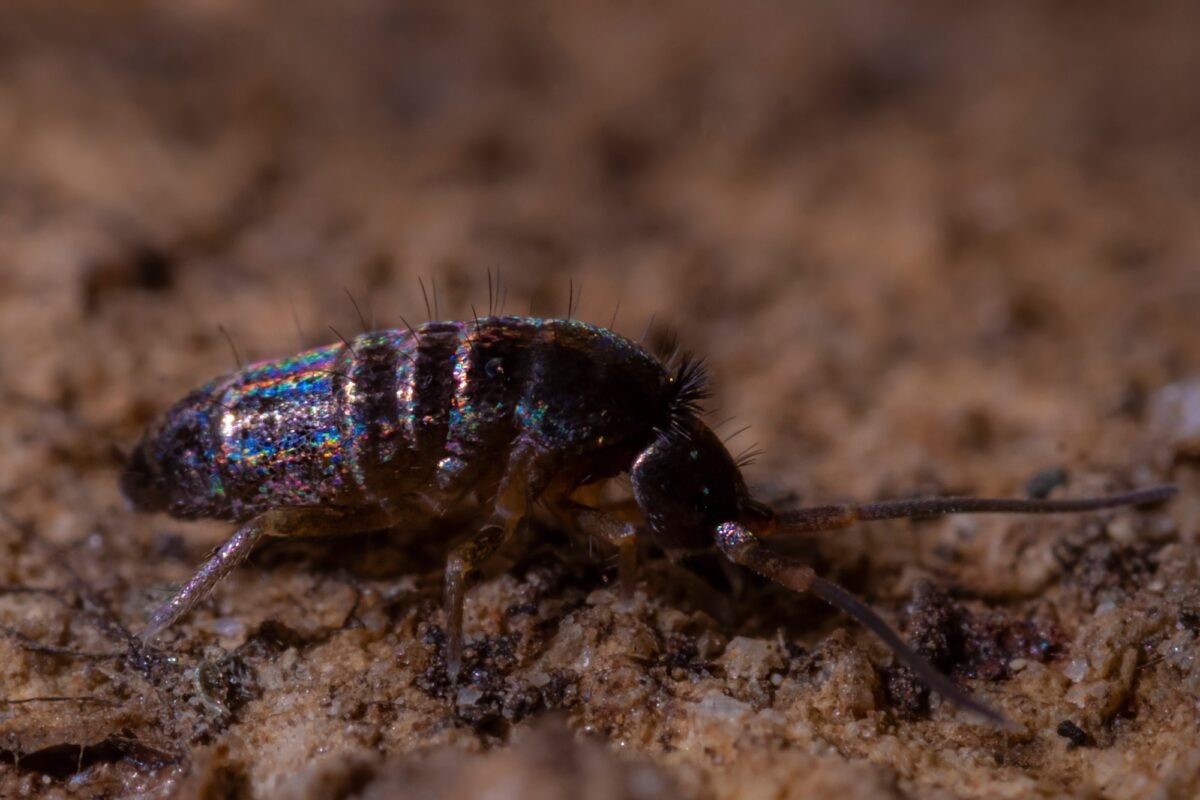
Buy Iridescent Blue Springtails from Springtails Culture → From $50.00 for 50 springtails. Advanced care. Very limited availability. Raised in-house in New Baden, Illinois.
Tomocerus minor — The Large Temperate Species
What It Is
Tomocerus minor is the temperate woodland representative of the Tomocerus genus — a large (up to 4.5mm), metallic silvery-blue springtail that brings the characteristic Tomoceridae iridescence to cool temperate woodland vivariums in a beginner-accessible package.
Where the Iridescent Silver and Blue are advanced collector cultures for showcase vivariums, T. minor is the practical temperate choice — genuine Tomoceridae iridescence, meaningful body size, and a well-documented ecological function as one of the most effective leaf litter processors in temperate ecosystems.
Scientific Significance
Tomocerus minor cultures do very well in captivity and provide a great, easily cultured food source for small terrestrial amphibians which are able to feed on fruit flies or pinhead cricket-sized prey.
Beyond its vivarium applications, T. minor is documented in scientific literature as a genuine leaf litter processor — its feeding and movement through leaf litter physically fragments organic material, increasing surface area and accelerating microbial decomposition at a measurable level. This makes it one of the most ecologically meaningful springtail species a woodland vivarium builder can add.
Care Requirements
| Parameter | Recommended Range |
|---|---|
| Temperature | 18–24°C (65–75°F) — cool temperate range |
| Humidity | Moderate to high — damp substrate with leaf litter |
| Substrate | Organic soil with leaf litter, bark, and woody material |
| Diet | Brewer’s yeast, fish flakes, leaf litter, dried mushroom |
| Container | Secure-lidded — Tomocerus are exceptional jumpers |
| Care Level | Beginner–Intermediate |
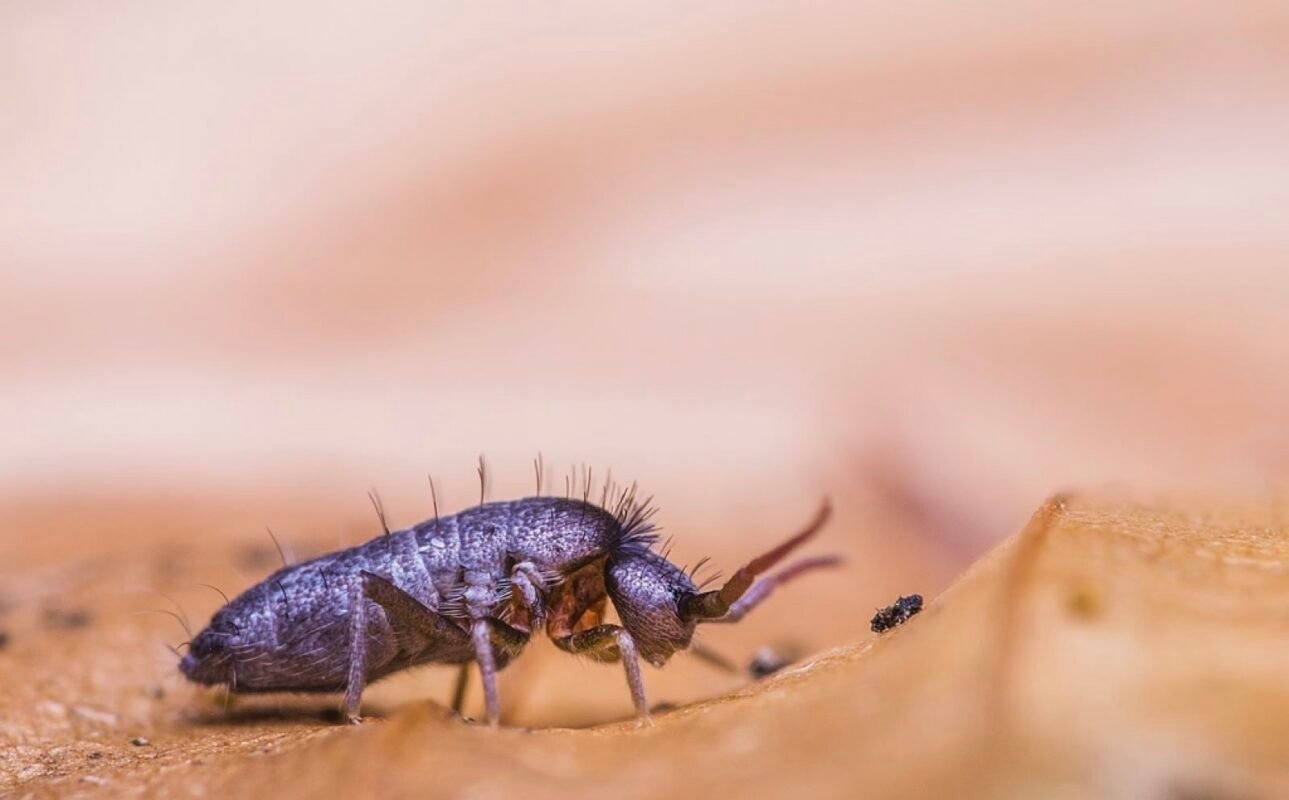
Buy Tomocerus minor from Springtails Culture → From $35.00 for 50 springtails. Beginner–Intermediate care. Raised in-house in New Baden, Illinois.
Tomocerus in a Vivarium — What They Actually Do
All three Tomocerus cultures perform the same core vivarium functions — cleanup crew detritivory at a large, visible body size that makes their activity observable to the keeper.
Mold and fungal control: Feeds on fungal hyphae, mold spores, and bacterial biofilm across substrate and wood surfaces. Their large body size means each individual processes more material per feeding event than smaller springtail species.
Leaf litter processing: Particularly effective in T. minor — physically fragmenting leaf litter and organic material through feeding and movement, accelerating decomposition.
Nutrient cycling: Their feeding activity drives the microbial loop in the substrate, converting organic waste into plant-available nutrients and supporting the living soil that makes bioactive setups function.
Visible cleanup activity: Unlike most springtail species, Tomocerus is consistently active on visible substrate surfaces — meaning the cleanup function is observable rather than happening entirely underground.
Live feeder function: At 4–6mm, Tomocerus is too large for most dart frogs and small amphibians. They function best as display animals and ecological workers rather than as feeder prey.
Plants and Tomocerus: The nutrient cycling activity of a Tomocerus colony in a showcase vivarium actively benefits live plant health through enriched substrate microbial activity. For premium tropical and temperate plants to build a showcase vivarium around, visit Variegated Plant Shop — their tropical selection pairs beautifully with the woodland aesthetic that Tomocerus inhabits.
Complete Care Guide — All Three Species
Housing
All three Tomocerus species require the same housing setup:
Culture container: Secure-lidded plastic tub of at least 6 litres. Leave 1.5–2 inches of empty space at the top — Tomocerus are exceptional jumpers and will exploit any gap in a lid or any substrate filled too close to the top.
Always open cultures over a clean container: The jumping ability of Tomocerus means individuals will launch during transfers. Opening over a clean, dry plastic container or sweaterbox catches jumpers and allows easy return to the culture.
Substrate
Organic soil with a moisture gradient is the ideal substrate for all three species. A porous chunk of cork bark can be laid on top of the substrate and tapped into the vivarium or a new culture when the springtails have colonised it.
Include:
- Organic topsoil base (2–3 inches)
- Leaf litter layer on top
- Pieces of cork bark or rotting wood for climbing and shelter
- Maintain damp but not waterlogged — a moisture gradient from wet base to drier surface is ideal
Temperature
Optimal reproduction seems to be between 65–75°F (18–24°C). All three Tomocerus cultures are temperate in nature — do not house in a warm tropical environment. Room temperature in most homes is appropriate without supplemental heating.
Feeding
- Brewer’s yeast — the primary food; a light weekly sprinkle on the substrate surface
- Tropical fish flakes — accepted readily; supplement the yeast diet
- Dried leaf material — natural food source; keep a layer of dried leaves in the culture
- Dried mushroom — occasional supplement for colony health
Add a very light sprinkling of brewer’s yeast every 2–4 days, or less often if yeast is still visible. Over the next few days the yeast will be devoured completely. Be careful not to over-feed, as it can overwhelm the culture causing a lack of oxygen.
Harvesting for Vivarium Seeding
Substrate can be transferred directly from the culture to seed your vivarium — tip the culture contents onto the vivarium substrate and allow the springtails to distribute themselves. Alternatively, place a piece of cork bark on the culture surface, allow Tomocerus to colonise it over several days, and then transfer the bark directly to the vivarium.
The Taxonomy Problem — T. minor vs T. vulgaris
This is a genuine and important issue in the hobby that most guides ignore — and it’s worth addressing directly.
Tomocerus minor and T. vulgaris can only be accurately confirmed by examination of the spines on the dens (part of the furcula). In T. minor these are tridentate — three teeth. In T. vulgaris they are simple — no teeth on the spines. Some springtails sold as Tomocerus vulgaris are actually T. minor. It is recommended to only sell stock under a name which has been properly verified via microscopy.
At Springtails Culture, we are transparent about this distinction. Our Iridescent Silver (Tomocerus minor/vulgaris) is listed honestly as both names — reflecting that the two species are visually almost identical and that species-level confirmation requires microscopic examination beyond standard hobby practice. Our Tomocerus minor temperate culture is the smaller, confirmed-minor species.
This matters because it reflects our broader commitment to species accuracy — the same commitment that leads us to list Tropical White as Collembola sp. rather than inventing a more impressive-sounding name, and to Thai Red as Lobella cf.rather than claiming false certainty about a genuinely uncertain identification.
We sell what we know. We name what we can confirm. And where we can’t confirm, we say so.
Who Should Keep Tomocerus Springtails?
Iridescent Silver and Blue — Advanced Keeper Profile
These are not beginner cultures. They are appropriate for keepers who:
✅ Have successfully established and maintained at least one other springtail culture ✅ Can provide stable temperate conditions (18–24°C) without significant fluctuation ✅ Are committed to the specific substrate, feeding, and container requirements ✅ Are motivated by visual payoff — collecting these species for their extraordinary appearance ✅ Have the patience for slower colony establishment than white or pink species
Not recommended for: First-time springtail keepers, keepers without temperature stability, or anyone who needs a fast-establishing functional cleanup crew rather than a display species.
Start here instead: Folsomia candida White Springtails — the most beginner-friendly and widely recommended starter species.
Tomocerus minor — Beginner–Intermediate Profile
T. minor is accessible to keepers with some experience who want to move into larger, more visually interesting temperate species. It is appropriate for:
✅ Keepers who have successfully kept Folsomia candida or another temperate species ✅ Woodland vivarium builders wanting a large, visible, leaf litter-processing species ✅ Keepers who appreciate the Tomoceridae iridescence in a more accessible culture
Where to Buy Tomocerus Springtails
All three Tomocerus cultures at Springtails Culture are raised in-house in New Baden, Illinois — from carefully maintained colonies on appropriate substrate, at appropriate temperatures, with species-accurate care. No reselling. No repackaging.
Iridescent Silver Springtails — From $35.00 → Giant 4–6mm. Silver, blue, purple iridescence. Advanced care. Available 50–1,000 springtails.
Iridescent Blue Springtails — From $50.00 → Giant 4–6mm. Deep metallic blue. Advanced care. Very limited availability. The crown jewel.
Tomocerus minor — From $35.00 → Up to 4.5mm. Metallic silvery-blue. Beginner–Intermediate. Temperate woodland specialist.
All three shipped Monday–Wednesday via USPS, FedEx, or UPS — your choice. Live arrival guaranteed on every order. Full shipping details here.
Summary — The Tomocerus Collection
The three Tomocerus cultures at Springtails Culture represent the full range of what this extraordinary genus offers the hobby — from the collector crown jewel of the Iridescent Blue, through the showcased shimmer of the Iridescent Silver, to the practical temperate elegance of Tomocerus minor.
Own all three and you have the complete Tomocerus collection — three expressions of the same fundamental biological spectacular, each optimised for a different context and a different keeper.
| Species | Price From | Care Level | Best For |
|---|---|---|---|
| Iridescent Silver | $35.00 | Advanced | Showcase vivarium, collector |
| Iridescent Blue | $50.00 | Advanced | Elite collector, crown jewel |
| Tomocerus minor | $35.00 | Beginner–Int. | Woodland vivarium, temperate |
Browse all Tomocerus cultures at Springtails Culture →
All raised in-house. All shipped Monday–Wednesday via USPS, FedEx, or UPS. Live arrival guaranteed.
New to springtails? Read our How It Works guide before ordering. Questions about Tomocerus care or availability? Contact us directly — we answer every message personally from New Baden, Illinois.
Also in the Collector Series: Thai Red Springtails — The Most Exciting Species Since 2021
Why are Tomocerus springtails so much more expensive than other species?
Three reasons. First, their slower reproduction rate means cultures take longer to build to sellable quantities. Second, they are genuinely rarer in dedicated culture than common white or pink species — fewer specialist breeders maintain them. Third, collector demand for the visual payoff drives premium pricing, particularly for the Iridescent Blue. The price reflects real scarcity and real cost to produce, not inflated marketing.
Can Tomocerus springtails be kept with other springtail species?
Yes — they coexist with other species without significant competition or predation. In a vivarium, Tomocerus occupies the visible surface and litter layer while smaller species like Folsomia candida work deeper in the soil. A Tomocerus + Folsomia candida combination provides complete substrate coverage across every depth layer.
Why do my Tomocerus springtails keep escaping?
Their jumping ability is exceptional — adult Tomocerus can leap 4–5 inches or more relative to body size. Two solutions: leave 1.5–2 inches of empty space at the top of the culture container, and always open the container over a clean dry plastic box that catches any jumpers during transfers.
Do Tomocerus springtails lose their iridescence?
They can lose scales if handled roughly or if conditions cause stress — and the iridescence is produced by those scales. Careful handling, appropriate temperature and humidity, and a low-stress environment maintain scale coverage and therefore iridescence. Scales lost during normal life are replaced through moulting cycles.
How long does a Tomocerus colony take to establish?
Slower than most species — expect 6–10 weeks to reach functional vivarium density at optimal temperatures (18–22°C). Patience during the establishment phase is the most important factor. Feed consistently but lightly and resist the urge to disturb the culture during this period.
What is the difference between the Iridescent Silver and the Iridescent Blue?
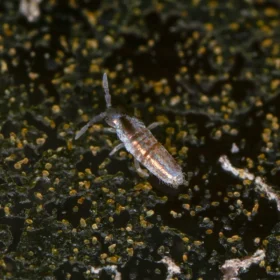
Same giant body size, same Tomoceridae scale-based iridescence mechanism, same care requirements — different colour expression. The Silver produces a broad iridescent shimmer across silver, blue, and purple tones. The Blue skews decisively toward deep metallic blue and is significantly rarer in dedicated culture, commanding a premium price accordingly.
Can Tomocerus springtails be used as dart frog feeders?
At 4–6mm, they are generally too large for most dart frog species and certainly for froglets. They function best as vivarium display animals and ecological workers rather than feeder prey. For dart frog feeders, Tropical White or Tropical Pink Large Form are more appropriate choices.
Is T. minor the same as T. vulgaris?
They are closely related species in the same genus, visually almost identical, and can only be definitively distinguished by microscopic examination of dental spine structure on the furcula. Many hobby cultures sold as one are actually the other. We list our Iridescent Silver honestly as Tomocerus minor/vulgaris to reflect this genuine taxonomic uncertainty rather than claiming false species-level precision.
