
Species Guides
Thai Red Springtails Complete Guide — The Most Exciting Species to Enter the Hobby Since 2021 (Complete Care & Culture Guide)
Apr
Published by Springtails Culture · New Baden, Illinois
Table of Contents
Thai Red Springtails Complete Guide
There are species that quietly join the hobby without much fanfare. And then there is Lobella cf. sp. “Thai Red” — a springtail so visually distinct, so behaviourally unusual, and so genuinely rare in dedicated culture that when it arrived in the hobby in 2021, experienced keepers stopped mid-scroll and paid attention.
Deep vivid red. Non-jumping. Substrate-visible. From the tropical forests of Southeast Asia. If you have ever dismissed springtails as invisible, anonymous white dots in the substrate — the Thai Red is about to change your mind entirely.
This is the complete guide: what Thai Red Springtails are, where they came from, how to keep them successfully, what to pair them with, and where to buy a culture you can actually trust.
What Are Thai Red Springtails?
Lobella cf. sp. “Thai Red” — commonly called the Thai Red Springtail or Red Thai Springtail — is a member of the family Neanuridae, a group of springtails characterised by one defining biological trait: a reduced or absent furcula. That means they don’t jump. At all.
In a hobby full of springtails that scatter explosively the moment a vivarium lid comes off, this is a remarkable distinction. Thai Reds move deliberately, predictably, and slowly through the substrate — making them one of the most manageable, most observable, and most display-worthy springtail species available to keepers today.
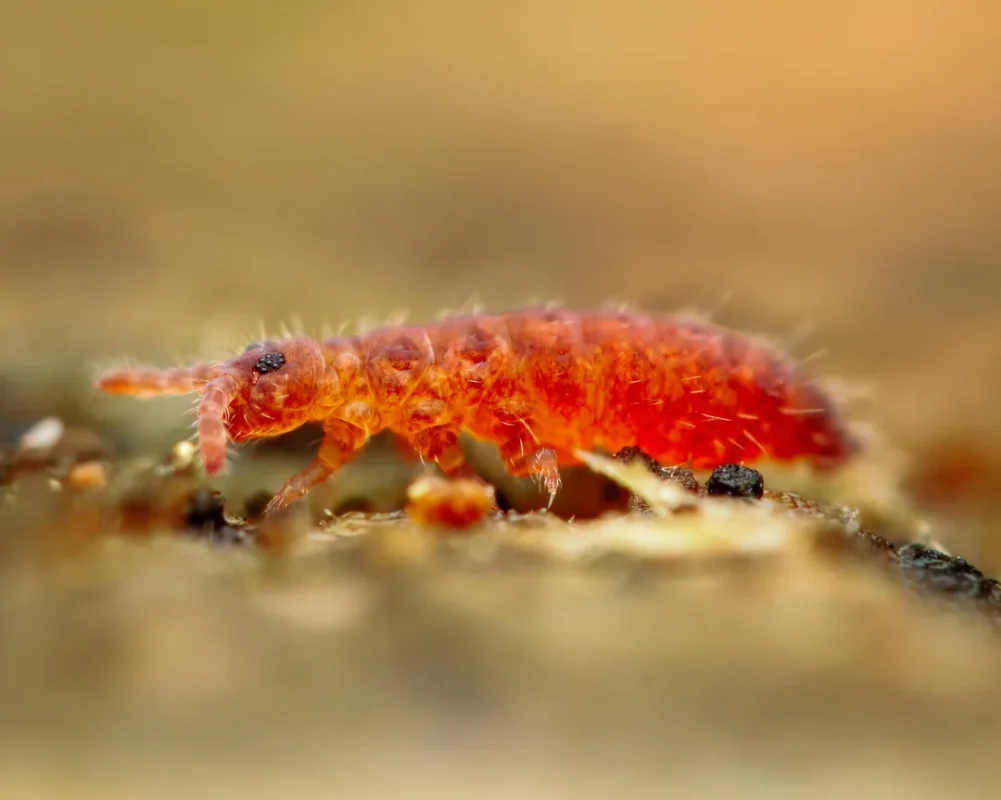
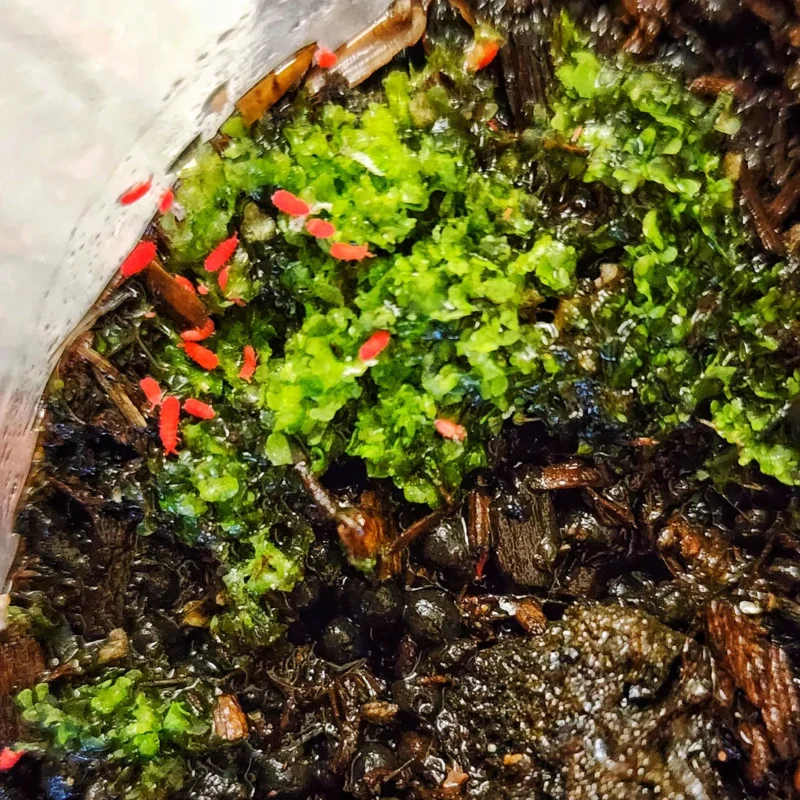
Their vivid red colouration — intense, solid, and unwavering regardless of lighting angle — makes them immediately visible against dark organic substrate, coco fibre, and leaf litter. When a feeding swarm covers a food source, the effect is one of the most visually spectacular moments the bioactive hobby has to offer. Imagine scattered embers crawling through the vivarium floor. That’s exactly what a healthy Thai Red colony looks like in motion.
Origin and Introduction to the Hobby
Thai Red Springtails were discovered in Thailand and found in humid regions — they were introduced to the hobby in 2021, making them a rare and exciting species for enthusiasts.
Their introduction was relatively recent by hobby standards, and dedicated cultures remain genuinely scarce. Most sellers who carry them are specialist suppliers who have invested in maintaining the specific conditions this species demands. At Springtails Culture, our Thai Red cultures are raised in-house in New Baden, Illinois — from a carefully maintained founding colony, under controlled temperature and humidity conditions, on the organic soil substrate this species requires.
This is not a species you’ll find at every store. And that’s exactly what makes it worth finding.
Why Thai Reds Are Different From Every Other Springtail
Most springtail species, when placed side by side, are functionally indistinguishable to the casual eye. Thai Reds are different in almost every way that matters:
Colour: Where the vast majority of hobby springtails are white, translucent, orange, or subtly tinted — Thai Reds are blazing red. There is nothing subtle about them. They are the most visually distinctive springtail species in general circulation.
Movement: Unlike typical springtails, Lobella sp. stay close to the substrate, making them ideal for controlled environments like terrariums. This behaviour makes them easier to manage and observe, especially in bioactive setups where stability is key.
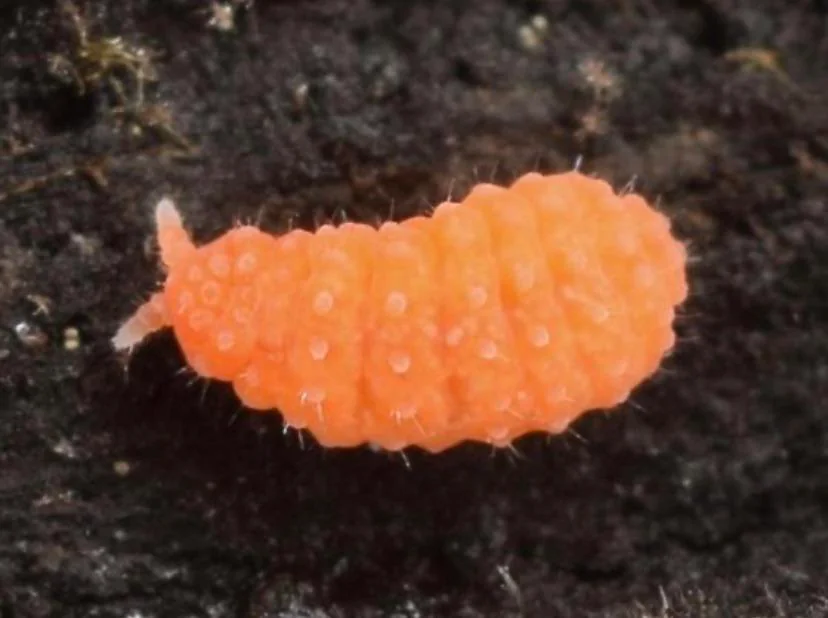
Body form: Unlike common springtails such as Folsomia candida, Lobella sp. Thai Red belongs to the Neanuridae family, characterised by a reduced or absent furcula, meaning they do not jump. They have a more robust, segmented, and slightly granular body, giving them a unique appearance similar to tiny isopods or larvae.
Visibility: Their size (1–2mm) combined with their intense red colouration means they are genuinely visible to the naked eye moving through dark substrate — something most springtail species simply cannot offer.
Thai Red Springtails in a Bioactive Vivarium
Despite their collector appeal, Thai Reds are serious detritivores. They are not merely display animals — they work, and they work continuously.
In a bioactive vivarium, Thai Reds feed on:
- Mold spores, fungal hyphae, and bacterial biofilm throughout the substrate
- Decaying leaf matter, rotting organic material, and dead plant tissue
- Animal waste, shed skin, and uneaten food within the substrate layer
- Bacteria, algae, and microbial films across substrate surfaces
By consuming decaying materials, they help break them down into smaller particles, facilitating the nutrient cycling process. This not only aids in the decomposition of organic matter but also enriches the soil with essential nutrients, promoting plant growth.
Their substrate-dwelling behaviour means they work deep in the organic layers where mold and decomposition begin — tackling the problem at the source, invisibly, continuously, and effectively.
Plants and Thai Reds: If your vivarium features live tropical plants — bromeliads, ferns, mosses, or aroids — the nutrient cycling activity of a healthy Thai Red colony actively supports root health and soil microbial balance. For premium tropical plants to pair with your bioactive setup, visit Variegated Plant Shop — their selection of tropical species is well-matched to the warm, humid conditions Thai Reds thrive in.
Thai Red Springtails as a Live Feeder
Red springtails Lobella Thai Red are an excellent live food for ants, reptiles, and amphibians. Ideal for bioactive terrariums, they help control mold and organic waste. Highly appreciated by hunting species, their bright red colour stimulates feeding response and makes them easy to spot.
For dart frog keepers in particular, the Thai Red offers a compelling dual function: a self-replenishing live food source whose vivid colour provides strong visual contrast against dark substrate, making them exceptionally easy for smaller frogs to locate and target. Their non-jumping behaviour means they stay exactly where a frog can find them — rather than bouncing unpredictably out of reach.
Complete Thai Red Springtail Care Guide
Housing
Transparent plastic or glass containers with secure lids are ideal, allowing you to monitor the population without disturbing the environment. The enclosure should provide adequate vertical space to allow for substrate layering.
A 6-litre plastic tub with a tight-fitting lid and small ventilation holes is ideal for a standalone Thai Red culture. The lid is important — while Thai Reds don’t jump, they climb well and will exploit gaps in an unsecured lid.
Substrate — The Most Critical Factor
This is where most Thai Red failures begin. This species has a non-negotiable substrate requirement:
Use organic soil only. A mix of organic top-soil, sphagnum moss, and leaf litter creates an excellent base. This substrate retains moisture well while providing organic matter for springtails to feed on. Avoid overly dense or waterlogged substrates to prevent anaerobic conditions that harm springtails.
Do not use charcoal or clay substrate. Thai Reds have a strong burrowing instinct and require organic soil deep enough to burrow through. Charcoal and clay substrates — appropriate for many other springtail species — will result in colony failure for Thai Reds. This is the single most important care distinction between this species and the rest of the hobby.
Incorporate small amounts of decaying wood pieces or leaf litter for added nutrition and microhabitat complexity.
Temperature & Humidity
| Parameter | Range |
|---|---|
| Temperature | 70–82°F (21–28°C) |
| Humidity | Very high — 80–100% |
| Lighting | Not required — prefer dark environments |
| Ventilation | Minimal — closed or near-closed lid |
These springtails thrive in a moist environment with a temperature range of 70–80°F (21–27°C). The warmer end of this range drives faster reproduction — a culture maintained at 78–82°F will establish and grow significantly faster than one kept at room temperature.
Feeding
Thai Reds are protein-driven compared to many other springtail species. A varied, regular diet drives the strongest colony growth:
- Brewer’s yeast — the hobby standard; sprinkle a small amount on the substrate surface weekly
- Tropical fish flakes — universally accepted; break into small pieces
- Spirulina powder — excellent protein supplement; a small pinch every two weeks
- Dried mushroom — particularly effective for Neanuridae species
- Small amounts of soft fruit — banana peel pressed into the substrate surface
Feed small amounts regularly rather than large amounts infrequently. Excess food in a warm, sealed culture creates CO₂ buildup and can crash a colony faster than almost anything else. When in doubt — feed less, more often.
Signs of a Healthy Colony
- Visible red animals moving actively through the substrate
- Feeding swarms forming around food sources within hours of addition
- New juveniles (smaller, lighter-coloured) appearing alongside adults
- Substrate surface appearing biologically active — fine tunnels and surface disturbance
Signs of a Struggling Colony
- Animals clustering at the walls or lid rather than in the substrate
- No feeding response after 24 hours of food addition
- Substrate becoming waterlogged, grey, or anaerobic-smelling
- Population declining without clear cause
If you see these signs, check substrate moisture (not waterlogged), temperature (within range), and food availability before assuming a crash. Many apparent crashes are temporary stress responses that resolve with minor environmental corrections.
How to Set Up a Thai Red Culture Step by Step
What you need:
- 6-litre plastic tub with secure, ventilated lid
- Rich organic soil (not clay, not charcoal)
- Sphagnum moss
- Leaf litter (oak or magnolia work well)
- Small pieces of rotting wood or bark
- Brewer’s yeast or springtail food
Setup:
- Add 2–3 inches of organic soil to the base of the container
- Layer sphagnum moss on top of the soil
- Add leaf litter across the surface
- Place a few small pieces of rotting wood on top
- Mist lightly with dechlorinated water until the soil is damp but not waterlogged
- Add your Thai Red culture — tip gently onto the substrate surface
- Add a small pinch of brewer’s yeast
- Close the lid and place in a warm location (74–82°F)
- Check after 48 hours — animals should be distributed through the substrate
Pairing Thai Reds in a Vivarium
For a complete bioactive substrate in a tropical vivarium, Thai Reds work best alongside a surface-active or deep-soil complementary species:
- Pair with Folsomia candida (White Springtails) for deep-soil mold control while Thai Reds handle the visible substrate and litter layer
- Pair with Tropical White Springtails for a complete two-species tropical system with surface and substrate coverage
- Add to a collection alongside Iridescent Blue Springtails for the most visually dramatic collector display possible — vivid red and deep metallic blue in separate enclosures
Who Should Keep Thai Red Springtails?
Thai Reds are not a beginner species. They reward keepers who understand and can replicate their specific habitat requirements. If you are new to springtails, we recommend starting with Folsomia candida or our Tropical White Springtails to build your understanding of culture management before moving to this species.
If you have successfully kept and maintained at least one intermediate springtail culture, you are ready for Thai Reds. And they are absolutely worth the progression.
The ideal Thai Red keeper is:
- Experienced with at least one other springtail species
- Able to maintain stable warm, humid conditions (74–82°F)
- Committed to organic soil substrate — no substitutions
- Patient — Thai Reds reproduce more slowly than white or pink species, and colony establishment takes longer
- Motivated by the extraordinary visual payoff of a thriving, vivid red colony
Where to Buy Thai Red Springtails
Buy Thai Red Springtails from Springtails Culture →
Every Thai Red culture from Springtails Culture is:
- Raised in-house in New Baden, Illinois — not resold, not repackaged
- Cultured on organic soil substrate matched to this species’ specific requirements
- Shipped Monday through Wednesday via USPS, FedEx, or UPS — your choice
- Backed by our live arrival guarantee — if it doesn’t arrive alive and active, we reship
Available in quantities from 50 to 1,000 springtails. From $35.00.
FAQ — Thai Red Springtails
Q: Are Thai Red Springtails hard to keep? A: Care level is intermediate to advanced. They are not difficult if you meet their two non-negotiable requirements — organic soil substrate and warm, consistently humid conditions. The most common failure is using the wrong substrate. Stick to organic soil only and keep temperatures at 74–82°F and the colony will establish reliably.
Q: Why can’t I use charcoal substrate for Thai Reds? A: Thai Reds are burrowers — they need organic soil deep enough to tunnel through for shelter and reproduction. Charcoal substrate, which works well for many other springtail species, does not provide the organic material or burrowing depth this species requires. Colony failure on charcoal is consistent and well-documented in the hobby.
Q: Do Thai Red Springtails jump? A: No. Lobella cf. sp. Thai Red belongs to the Neanuridae family — a group characterised by a reduced or absent furcula (the springtail jumping apparatus). They are substrate-dwelling, slow-moving, and completely non-jumping. This makes them easier to manage, observe, and contain than most springtail species.
Q: How long does it take for a Thai Red colony to establish? A: Thai Reds reproduce more slowly than white or pink springtails. Expect 6–10 weeks for a colony to reach functional density at optimal temperatures (78–82°F). At cooler temperatures, establishment takes longer. Patience and consistent feeding during the establishment phase are the most important factors.
Q: Can Thai Red Springtails be used as dart frog feeders? A: Yes — their vivid red colouration provides strong visual contrast against dark substrate, making them easy for frogs to locate and target. Their non-jumping behaviour means they stay within reach. They are appropriate for adult frogs and larger dart frog species. For froglets and juveniles, the smaller body size of white or pink springtail species is more appropriate.
Q: What temperature do Thai Red Springtails need? A: 70–82°F (21–28°C), with optimal reproduction occurring at the warmer end of that range. A culture maintained at 78–82°F will establish and grow significantly faster than one kept at room temperature.
Q: Can I keep Thai Reds with isopods in the same vivarium? A: Yes — Thai Reds coexist well with isopods and complement them ecologically. Isopods handle macro-waste while Thai Reds handle micro-level mold, fungal growth, and finer organic material. Together they create a complete self-sustaining cleanup system.
Q: How often should I feed Thai Red Springtails? A: Small amounts once or twice per week is ideal. Rotate between brewer’s yeast, tropical fish flakes, spirulina, and dried mushroom for the healthiest, most protein-rich diet. Never add large amounts at once — overfeeding is one of the most common causes of culture failure.
Summary — Is the Thai Red Worth It?
Yes. Unequivocally.
It is a slower-moving culture to establish than most. It demands organic soil and warm temperatures without compromise. It reproduces at a more measured pace than common white or pink species. But when a Thai Red colony is thriving — vivid red animals moving visibly through dark organic substrate, feeding swarms forming on demand, new juveniles appearing — it is one of the most rewarding and visually spectacular cultures in the entire hobby.
There are springtails. And then there is the Thai Red. The difference is immediately obvious to anyone who has seen a healthy colony in person.
Order Your Thai Red Springtail Culture Here →
Raised in-house. Shipped alive. Guaranteed.
New to springtails? Read our How It Works guide before placing your first order — it walks you through species selection, quantities, seeding, and exactly what to do when your culture arrives.
Have questions about Thai Reds or any other species? Visit our FAQ page or contact us directly — we respond to every message personally.
